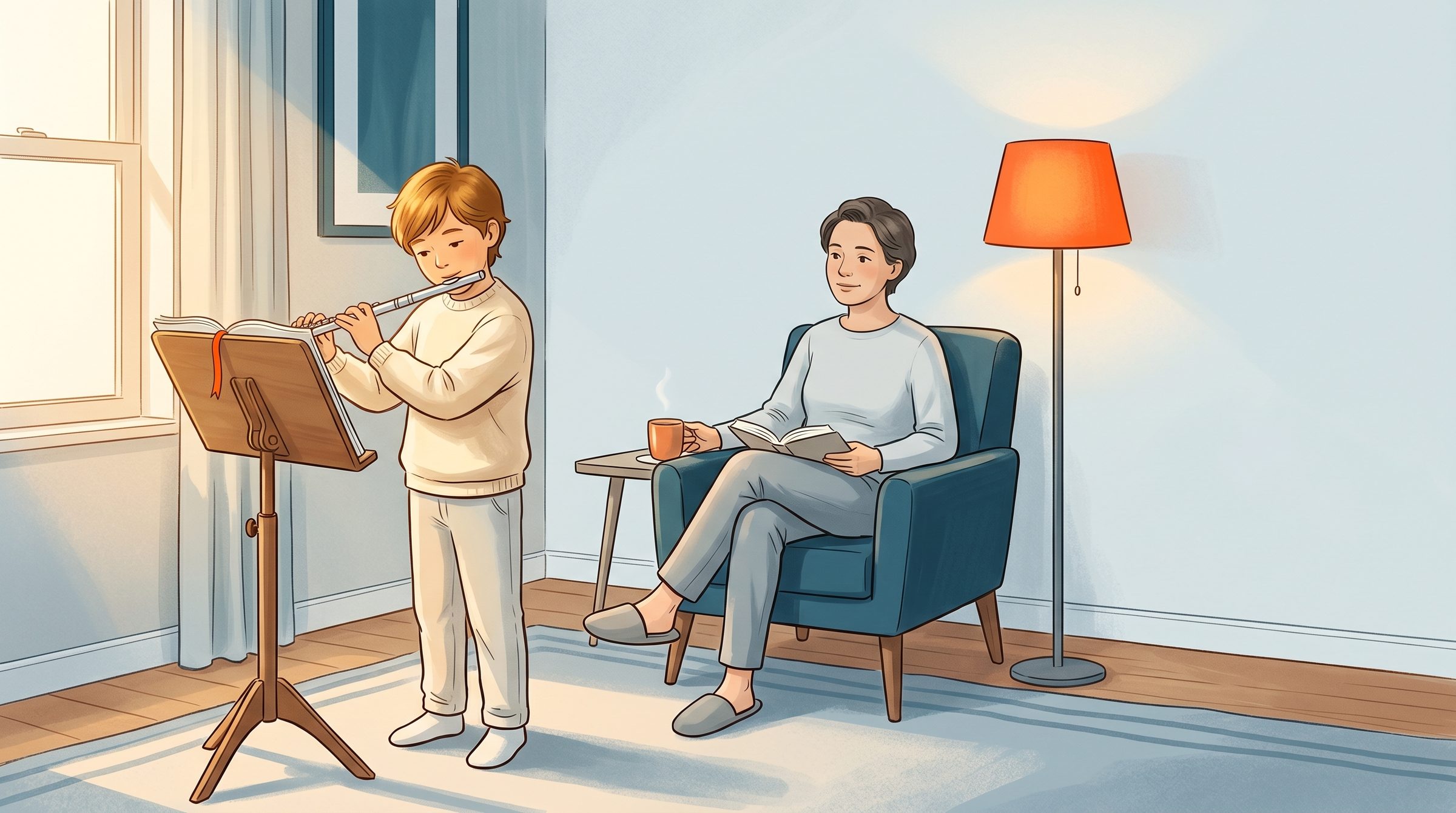
Your eight-year-old comes home from a flute lesson with a new piece, and the teacher says to practice it five times this week. You don't read music. You can't tell whether the rhythm is right or whether the tone is improving. That's what most parents wonder when they try to figure out how to help their child practice music — and the answer has very little to do with reading music yourself.
You Do Not Need to Be a Musician to Support Your Child
The most influential adult in a young musician's progress is rarely the teacher. It is the parent who decides when, where, and in what mood practice happens at home — even if that parent has never played an instrument.
Suzuki teachers have built their method around this. The Suzuki Music Institute's advice is to sit with your child during practice, especially between ages 3 and 8, and to attend or record lessons so you know the teacher's goals for the week, not only the assigned pieces. [1]
Your job is environmental and emotional, not technical. You set the schedule, the space, and the tone. Get those three right and most of the rest takes care of itself. Leave the correcting of mistakes to the teacher. [3] [2]
What Good Practice Looks Like (So You Can Recognize It)
There is a meaningful difference between practicing and playing through a piece. Playing through means starting at the top and going to the end at full speed. Practicing means stopping, slowing down, and repeating the parts that don't work yet.
Decades of deliberate-practice research, beginning with Ericsson's 1993 study of expert performers, found that real progress comes from focused, effortful work on specific weaknesses — not from raw hours. Playing on autopilot has a cost: once a skill runs automatically, extra repetition stops producing improvement, and experts deliberately seek out harder tasks to avoid that stall. [7]
What this looks like at home: your child stops in the middle of a passage, plays the same two bars three or four times slowly, then tries again. That is not getting stuck. That is the most productive thing they can do; NPR's guide for parents suggests a five- or ten-minute session can aim at just one or two bars. [4]
The pause matters too. In a 2022 study of 32 players aged 11 to 28, Palese and Duke found that school-aged players seldom paused to think during practice, and often worked on problems other than the ones they had just identified. [8]
If every session is one full run of the piece followed by "I'm done," progress will be slow regardless of how many minutes were logged. For a deeper look at how a focused session is structured, you can share how to practice music at home with an older child as a starting point.
How to Build a Practice Routine That Sticks
Routine is one of the few practice variables a parent can fully control. Most teacher guidance for parents favors short, daily practice over long catch-up sessions on weekends.
For most children under 12, a focused 15 to 20 minutes per day is more productive than 45 minutes of dwindling concentration. One teacher-written guide offers five minutes per school grade (25 minutes in 5th grade) as a rough idea of what a child can handle. [2] Adolescents can sustain longer, but a short focused session beats a longer unfocused one. [5] Even the expert performers in Ericsson's research practiced without rest for only around an hour. [7]
Pick a recurring slot — same time, same chair, same music stand — and protect it. A fixed time takes the remembering and the decision-making out of the equation, and quietly removes the daily "should I practice now?" negotiation that derails so many families. [2]
What to Do When Your Child Gets Frustrated
Frustration is not the enemy of practice. It usually means the child has reached the edge of what they can do, which is also where progress happens.
The better move is to acknowledge the feeling, take a small break, and end the session on a successful pass — even if it means going back to an easier passage. The goal is to protect tomorrow's willingness to start. The Suzuki Music Institute puts it plainly: be patient, be kind, and if a practice day goes badly, there is always tomorrow. [1]
What does damage is forcing through a meltdown. Pushing past tears in the name of discipline risks teaching the child that the instrument is what causes the bad feeling. Musicologie's teachers warn parents against forcing practice for this reason: a child pushed too hard can burn out and lose the love of music that made them want to play. [2]
If the same piece causes frustration day after day, that is information for the teacher — not a sign that your child is the problem. A short note before the next lesson ("Bar 12 is becoming a battle") usually changes the lesson plan.
How to Stay Involved Without Taking Over
There is a fine line between supportive and intrusive, and crossing it tends to backfire. Children whose parents constantly correct technical details often disengage from practice altogether — the autonomy is gone, and so is the motivation.
Effective parents tend to praise specifically. "I noticed you went back and fixed that rhythm three times" lands differently than "that sounded great." Parenting expert Noël Janis-Norton, speaking to Suzuki parents, calls this descriptive praise: describe exactly what the child did right, with no "Good job!" tacked on, so the child learns what correct looks like. [6]
Resist the urge to be the second teacher — the teacher teaches, you make practice happen. [5] Confusing those roles is one of the most common reasons families end up in conflict around the instrument.
Tools That Give You Visibility Into Your Child's Progress
The hardest part of being a non-musician parent is the feeling that practice is happening behind a curtain. Your child plays for thirty minutes, you hear noise, and you cannot tell whether anything actually improved. Three categories of tool can pull that curtain back.
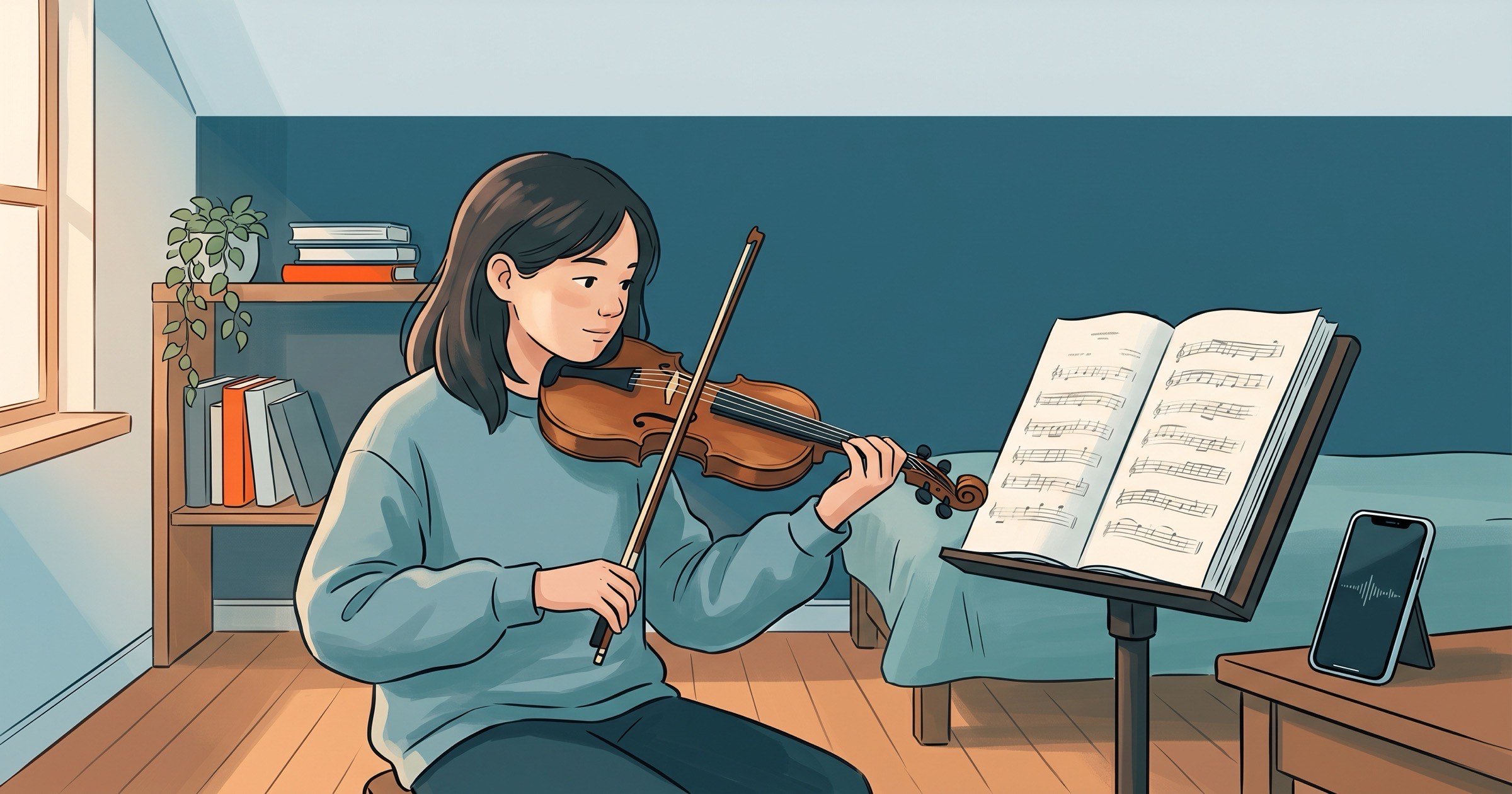
Recording. Even a phone voice memo, played back the next day or the next week, lets your child (and you) hear progress in tone, rhythm, or fluency. Recordings also give the teacher data between lessons — useful when something is going wrong at home that does not show up in front of the teacher.
Practice journals. A short list at the end of each session — what was practiced, what got better, what is still hard — turns practice into a tracked process. Teachers can review it. You can spot patterns over weeks.
AI-driven practice apps. Tools like AIMU listen to each session, mark which notes need attention, and produce visual progress reports a non-musician can read. The chart goes up or it does not — no musical literacy required.
None of these replace the teacher. They give you something teachers have always wanted parents to have: an honest view of what is actually happening between lessons, in language that does not require musical training to interpret.
Questions Parents Often Ask
How long should my child practice each day?
For most children under 12, a focused 15 to 20 minutes daily is a sensible target, and it builds a better habit than 45 minutes once or twice a week. Adolescents can usually sustain 30 to 45 minutes if the session has clear sections — warm-up, hard passages, review. Quality stops climbing once attention fades; that is the real limit, not the clock.
What should I do if my child wants to quit?
Talk to the teacher first. A quit signal usually points to one of three things: a piece that has been frustrating for too long, a routine that has become a fight, or a real loss of interest. Each has a different fix, and pulling the plug too quickly closes off the first two.
How can I tell if my child is improving without being able to hear it?
Look for indirect signs: how often the same passage reappears in practice, how long it takes for a new piece to become recognizable, how many sessions end on a positive note. Recording the same piece every two weeks and listening side-by-side is a simple way to catch progress that is invisible day-to-day.
The biggest gift a non-musician parent can give a young musician is not musical knowledge — it is a steady environment, a consistent routine, and a calm response when things get hard. What technology like AIMU adds is a window into what is actually happening during practice: which notes the AI marked, which passages improved across the week, and where the next lesson should focus. It is not a replacement for the teacher's ear — it is a translation layer for parents who do not have one.
Further reading
- Eight Tips to Help Your Child Practice at Home (Brad Gant, Suzuki Music Institute)
- How to Practice: A Guide for Parents and Caregivers (Musicologie)
- 5 Easy Steps to Help Your Child Practice at Home (Kinga Krupa)
- Getting Kids To Practice Music — Without Tears Or Tantrums (Anastasia Tsioulcas, NPR / Deceptive Cadence)
- Creating an Optimal Music Practice Environment for Your Child (Elizabeth Leehey)
- Music Practice with Your Child: How to Make It Work Better (Laurie Niles, Violinist.com)
- The Influence of Experience and Deliberate Practice on the Development of Superior Expert Performance (Ericsson, 2006, Cambridge Handbook of Expertise, ch. 38)
- Thinking Time in Music Practice (Palese & Duke, 2022, Update 41(1))