A violin student practices for 90 minutes and still stumbles on the same passage. The next day, it's worse. This is not a motivation problem; it is a structure problem. Most students who say they practice a lot are really just playing through their pieces, reinforcing the same mistakes. Learning how to practice music at home with a clear plan is the difference between a year of frustration and a year of real progress.
Why Home Practice Decides Your Progress
Most of the work of learning an instrument happens between lessons, not during them. A teacher can show you what to fix in thirty minutes; the other six days of the week decide whether you actually fix it.
When home practice is unfocused, those six days can undo the thirty minutes. When it is structured, they multiply it. Research on expert performance by K. Anders Ericsson found that experience alone stops paying off once your playing becomes routine; what keeps advanced musicians improving is time spent on a specific kind of effortful work, which he called deliberate practice. [1]
This is good news. You do not need to practice more hours to improve. You need to change the shape of the hours you already have.
Practicing vs. Just Playing Through
Playing a piece from start to finish and calling it practice is one of the most common traps in music study. It feels productive. It mostly is not — at least not by itself.
Deliberate practice, as Ericsson describes it, requires identifying the specific weak spots in your playing and working on them until they change. [1] The goal of practice is not to perform the piece; it is to improve it. Those are very different tasks.
A 2014 meta-analysis led by Brooke Macnamara put a number on how much accumulated deliberate practice actually explains. Across the studies it pooled, deliberate practice explained 21% of the variance in music performance — real and significant, but less than the strongest versions of the Ericsson story had argued. [2] The practical takeaway is balanced. Practice matters a lot. It does not decide everything — the authors point to other candidates for the rest, such as the age you start and general abilities like working memory.
That is actually good news for most students. You do not need to be a prodigy to improve meaningfully; you just need to practice well. Playing-through has a place — you need to test flow and endurance before a performance. But most of your home practice should be something else entirely.
How to Structure Your Home Practice Session (Step by Step)
Use a short, focused block rather than a long sprawling session. Gerald Klickstein, in The Musician's Way, recommends playing "no more than 25 minutes" in solo practice before taking a 5-minute breather; for group rehearsals he suggests 10 minutes of rest after 50. [4] Noa Kageyama goes further: "practicing more than one hour at a time is likely to be unproductive," and the evidence he surveys suggests "little benefit from practicing more than 4 hours per day," with returns starting to decline after about two hours. [5]
Here is a session shape that works for most intermediate students:
1. Warm up (5–8 minutes). Long tones, scales, or simple technical patterns that move the fingers and ears without demanding repertoire-level concentration. The goal is to transition your body and mind into practicing, not to burn time.
2. Focused section work (15–30 minutes). Pick the two or three hardest bars of the piece you are working on. Not the piece — the bars. Play them slowly, correct what went wrong, play them again. Stabilize the passage at a slow tempo first, then raise the tempo gradually once the notes stop moving under your fingers.
3. Integration (5–10 minutes). Play a slightly larger chunk containing the difficult passage, at moderate speed, to check whether the improvement survives in context.
4. Review (3–5 minutes). Run the passage or the movement once at something close to performance tempo, then stop. Finishing on something that went well protects your motivation for the next session.
Take a real break between blocks — five to ten minutes, enough to rest your ears and hands. Not a scroll-on-your-phone break. Klickstein's rule of thumb is a five-minute breather after a 25-minute block; he advises taking breaks even when you don't feel tired, because pausing before fatigue arises helps both your wellbeing and your learning. [4]
If you only have twenty minutes, you still do all four steps; you just shrink each one.
The hardest bars are usually smaller than you think. Circle the two beats that trip you up — not the whole line — and work on just those.
Five Mistakes That Slow Down Home Practice
Most plateaus come from a handful of specific habits, not from a lack of effort. Five show up the most:
Starting with the easiest piece. Your attention is best in the first ten minutes. Spending them on repertoire you mostly know wastes that window. Save the high-attention block for the passages that actually need it.
Running full tempo before the passage is stable. Playing a difficult bar at performance speed before the motor pattern is reliable is how mistakes become permanent. Slow the passage until you can play it cleanly, then raise the tempo only when the notes stop breaking. This is one of the most consistent recommendations across serious method books and studio teachers, and it is how experienced musicians are almost always taught to approach difficult passages.
Skipping the metronome because it feels boring. A metronome is not a time-keeper. It is a diagnostic tool that exposes rhythmic inconsistencies you cannot feel on your own. If you have not used one in a week, you have almost certainly drifted.
Mistaking repetition for learning. Playing a passage until it sounds good in that moment is not the same as learning it. Noa Kageyama calls this the learning-performance distinction: performance is how well you can play a passage while you are working on it; learning is whether you can still play it cleanly the next day, when it counts. Repetition builds the first — a momentary illusion of mastery — and often does not build the second. [6]
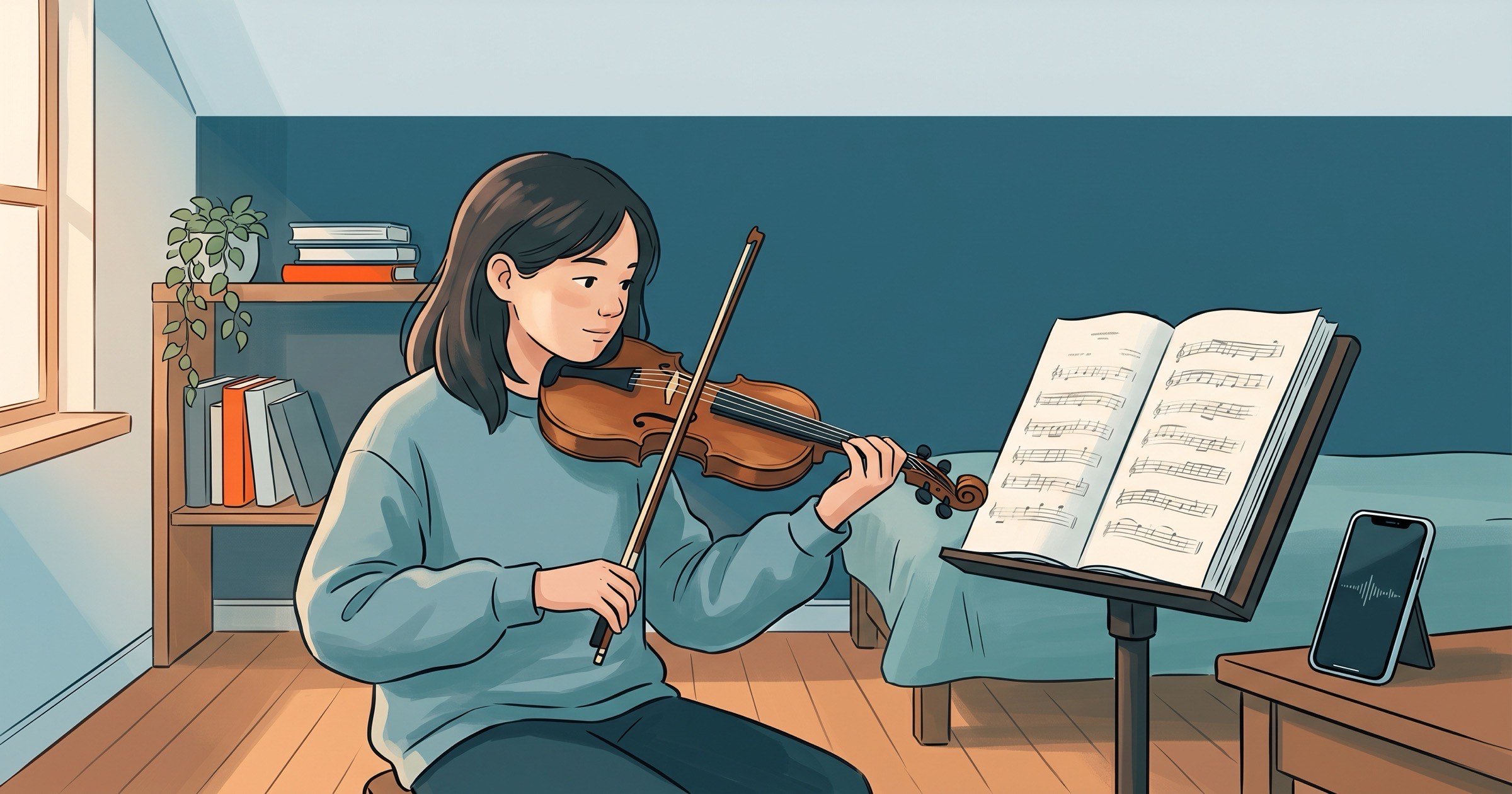
Never recording yourself. What you hear while playing is not what comes out of the instrument. A phone recording is the fastest way to close that gap.
How to Tell You're Actually Improving
Progress in music is not linear, and the feeling of improvement is not a reliable signal. Some days you will play the same passage worse than yesterday. That does not mean you are going backwards; it usually means your brain is reorganizing the skill.
Short plateaus are a normal part of learning. A stretch of two or three weeks where nothing seems to move is expected when your technique is consolidating. Longer stretches are a signal to change strategy, not to practice more.
Three honest markers that you are actually improving:
- The passage fails in a new way, not the old way — that means you fixed one problem and uncovered the next.
- You can play it slightly slower than before with fewer errors. Clean at slow speed almost always becomes clean at fast speed within a few sessions.
- Your recordings from a month ago sound worse than you remember them. This is the most reliable signal of all.
If you are stuck for more than two weeks on the same specific problem, it is time to change strategy, not add hours. Change the angle: practice the passage backwards, in altered rhythms, or with a different articulation. Changing what you are paying attention to is often what breaks a plateau, not more repetitions of the same attempt.
Tools That Make Home Practice Smarter
No single tool fixes practice, but a small set of them can remove the guesswork. A metronome and a tuner are the non-negotiable base; beyond those, two categories help most.
Recording tools. Your phone is fine. The point is to make listening-back a habit, not to produce a beautiful recording. Palese and Duke's 2022 paper notes that expert musicians often record and review their practice, because recordings let you "step outside" your own internal perceptions, while surveys find that school-age players rarely record themselves. In their study, players who first judged their playing in silence and then heard a recording identified more mismatches with what they intended the second time; the authors suggest judging first, then listening back to confirm or extend that judgment. [3] Listen once for overall shape, once specifically for intonation, and once specifically for rhythm. What you miss while playing almost always surfaces on playback.
Feedback tools that analyze the recording for you. An AI companion like AIMU listens while you play and marks the specific notes where pitch, rhythm, or articulation drifted — so your next repetition focuses on the two beats that actually need it, not the whole page. It is not a replacement for your teacher. It is a way to keep the lesson running between lessons.
Practice journals, metronome apps with subdivisions, and score-marking apps all have their place. But if you added one thing to your current routine, recording yourself — or having a tool listen for you — would move the needle most.
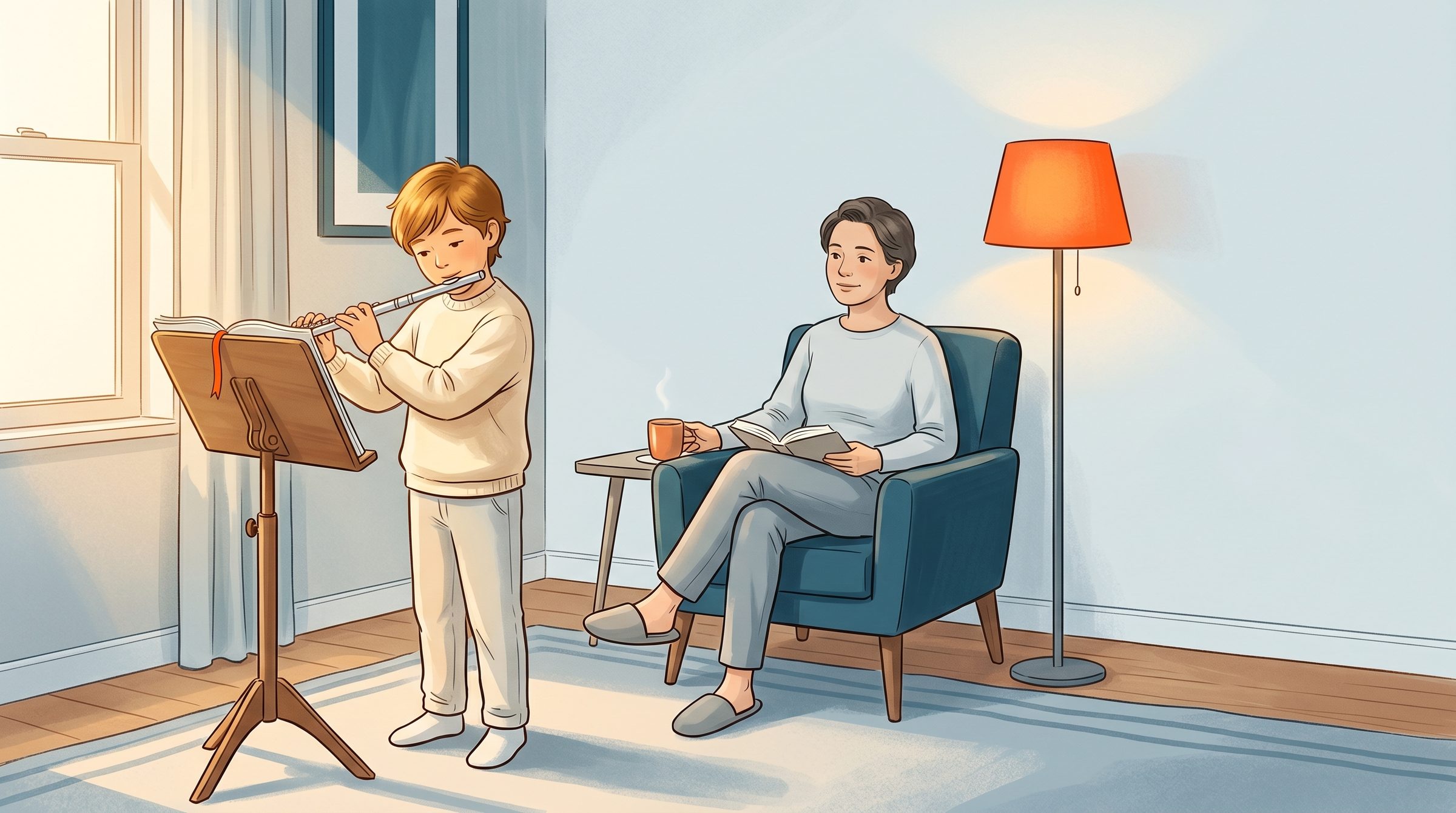
For a sharper shortlist of techniques, see 10 practice tips that actually work for music students. If a parent is reading this and wondering how to support the practice at home, this guide is for them.
Practice Smarter, Not Longer
Good home practice is not a longer practice session. It is a better-shaped one. Pick one block today — ideally the two hardest bars of your current piece — and give them the deliberate-practice treatment: slow, focused, recorded. Do that for a week and you will hear the difference.