The teacher said your child should practice "every day," but did not say for how long. You don't know if fifteen minutes is too little, forty-five minutes is too much, or whether the answer depends on age. If you've been wondering how long should my child practice music each day, the honest answer is: it depends on age, attention, and what you mean by "practice". Research doesn't prescribe minutes by age, but it says a lot about what makes practice time count.
The Short Answer: Daily Beats Long, Quality Beats Quantity
Learning research consistently favors spreading practice out over cramming it into one long session. Quality matters as much as time: Ericsson's work on expert musicians found that improvement comes from focused, effortful practice, and that routine repetition mostly keeps a player where they already are. [1]
Music-specific research on session length is thin. Stambaugh and Demorest, testing how the order of practice affected young clarinet and saxophone players in a single 18-minute session, noted how little research exists on this question. [3]
Practical translation: twenty minutes a day, six days a week will usually do more than a single two-hour session on Saturday. The numbers in this article assume daily sessions. Skip a day occasionally and nothing breaks. Skip three or four days and the previous week's work starts to fade.
Practice Time by Age: A Parent's Guide From 5 to 18
These ranges are common teacher guidance, not research findings. Treat them as realistic ceilings for focused practice, not aspirational targets. A child who practices below these numbers is not falling behind. A child who practices above them without complaint is unusual.
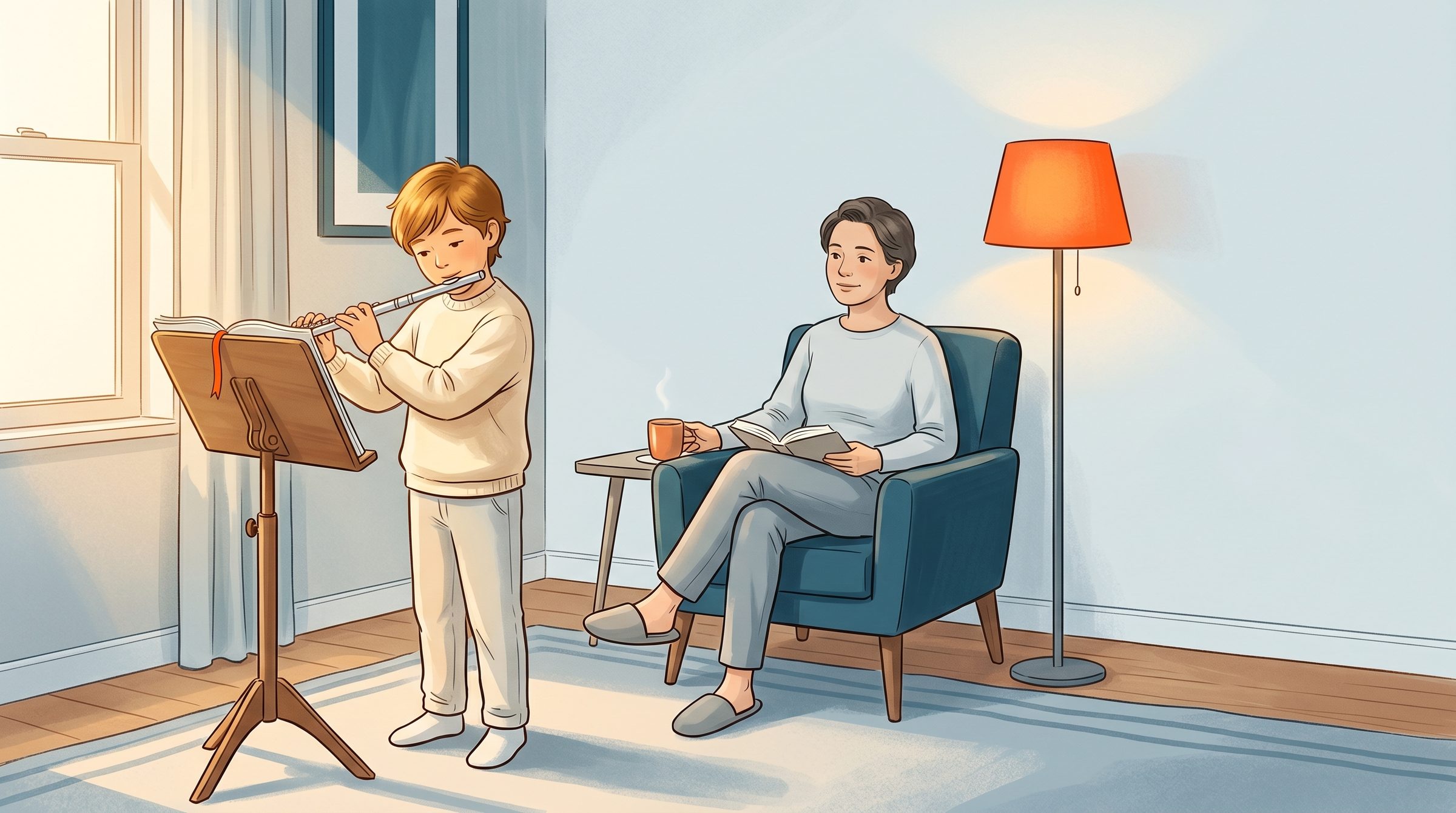
Ages 5 to 7: 10 to 15 minutes per day. Sustained attention at this age is genuinely short, and quality drops sharply past fifteen minutes. Two five-minute sessions can work better than one ten-minute one. The Suzuki tradition, which deliberately starts very young, stresses that parents sit with children aged 3 to 8 while they practice. [5]
Ages 8 to 10: 15 to 25 minutes per day. The child can begin to manage a structured session: a brief warm-up, a focused chunk on a hard passage, and a closing review piece. Past twenty-five minutes, expect quality to slide unless the child is unusually focused.
Ages 11 to 12: 25 to 40 minutes per day. Concentration is longer and self-regulation begins to develop. This is also the age where many students hit their first real plateau, which can be misread as needing more time when it actually needs better-structured time.
Ages 13 to 15: 30 to 60 minutes per day, often split. Adolescents can sustain longer focus, but motivation becomes the bottleneck. A serious student at this age might work in two thirty-minute blocks rather than one continuous hour.
Ages 16 to 18: 60 to 120 minutes per day for serious students; 30 to 60 minutes for casual ones. Late-adolescent music students aiming at conservatory may approach pre-professional volumes — but even then, the work is broken into focused blocks, not continuous play.
Krampe and Ericsson's study of expert and amateur adult pianists is worth knowing for one finding: the best pianists had practiced around 8,000 hours more than amateurs of the same age. That gap came from years of steady daily practice, not from any single dramatic year. [1]
The Attention Cliff: When Practice Stops Working
Ericsson found that deliberate practice demands a level of concentration people can sustain only for limited periods. Once concentration goes, practice turns into routine playing, which keeps a skill where it is rather than improving it. [1]
For elite adult performers, that limit is around an hour of practice without rest. [1] For children the window is shorter; many teachers see focus fade within fifteen or twenty minutes. And a tired child can usually still hear what went wrong. Palese and Duke found that school-age players spotted their own mistakes as well as college musicians did, but seldom stopped to fix them and often worked on something else instead. [4]
What this means in practice: a child who has been practicing for thirty minutes and is starting to wander, miss the same notes, or sigh, is not being lazy. They have hit the cliff. The next ten minutes of practice will mostly repeat what is already there, mistakes included. Stopping at the cliff is not giving up — it is recognizing that the productive part of the session is over.
Why Daily Practice Outperforms Weekend Marathons
Part of motor learning happens after practice ends, including during sleep. A daily session gives that consolidation a chance to happen six or seven times a week. A weekend marathon gives it one.
This is also why missing two or three days in a row is more costly than the calendar suggests. The child has not just lost the practice time — they have lost the consolidation that was supposed to happen between those sessions. Coming back after a four-day gap usually feels like starting partway over.
The pragmatic rule: aim for six days a week, and treat the seventh day as a rest day rather than a missed day. A real rest day is fine. A pattern of three skipped days followed by an hour of "catch-up" is not.
How to Tell Whether Your Child's Practice Time Is Productive
You don't need musical training to tell the difference between productive and unproductive practice. The signals are behavioral, not technical:
- Productive practice has stops in it. Your child plays a passage, stops, plays it slower, stops, plays it again. Silence in a practice session usually means thinking, which is the actual work.
- Unproductive practice sounds like one continuous run-through. The child plays the piece from start to finish, doesn't go back to fix anything, and reports they're "done."
- Productive practice produces tired focus. Your child finishes a session looking mildly worn out, not bored or hyper.
- Unproductive practice often runs long. Counterintuitive but consistent — when a child cannot find the difficult parts to work on, they fill the time with full-piece run-throughs and the session expands.
If you mostly hear continuous playing without pauses, the issue is rarely the duration. It is the structure — and that is something to raise with the teacher, not to fix by adding more minutes.
When More Time Helps — and When It Hurts
More practice time helps when the child is approaching a deadline (recital, audition, exam), when the structure is good and they want to consolidate, or when they have specifically asked for it. More time hurts when the child has already hit the attention cliff for the day, when they are being pushed past resistance, or when the parent is using duration as a way to manufacture progress that isn't happening for other reasons.
If you've been doing the right things and progress still feels stalled, see how to help your child practice music for the routine and mindset side, or share how to practice music at home with an older child for a session-level structure they can apply themselves.
The number of minutes is rarely the lever that breaks a plateau. The structure of those minutes almost always is.
A small but useful habit: at the end of each week, instead of asking how many total minutes were practiced, ask which two or three specific things actually got better. If you can name them, the time was productive — even if the total was modest. If you can't name anything, more time would not have helped, and the conversation to have is with the teacher about session structure.
This is also where tools like AIMU can help non-musician parents specifically: by listening to the session and producing visual reports of which passages improved across the week, they make the quality of practice — not just the duration — visible without requiring the parent to evaluate the playing themselves. It is the chart going up or not going up, in language a parent can read.
Further reading
- The Influence of Experience and Deliberate Practice on the Development of Superior Expert Performance (Ericsson, 2006)
- Maintaining Excellence: Deliberate Practice and Elite Performance in Young and Older Pianists (Krampe & Ericsson, 1996)
- Effects of Practice Schedule on Wind Instrument Performance (Stambaugh & Demorest, 2010)
- Thinking Time in Music Practice (Palese & Duke, 2022)
- Eight Helpful Tips to Help Your Child Practice at Home (Suzuki Music Institute)
- 5 Easy Steps to Help Your Child Practice at Home (Kinga Krupa)