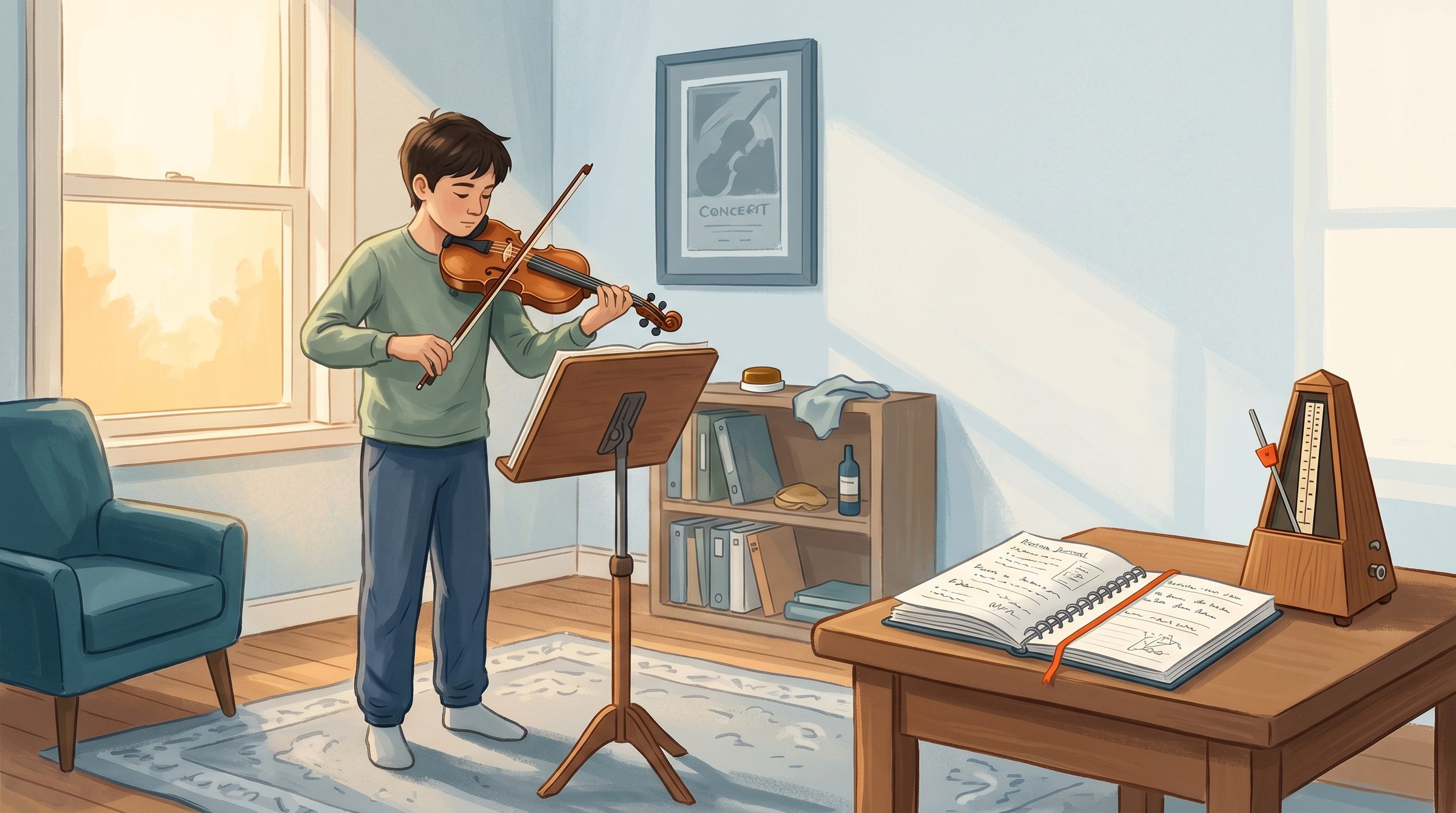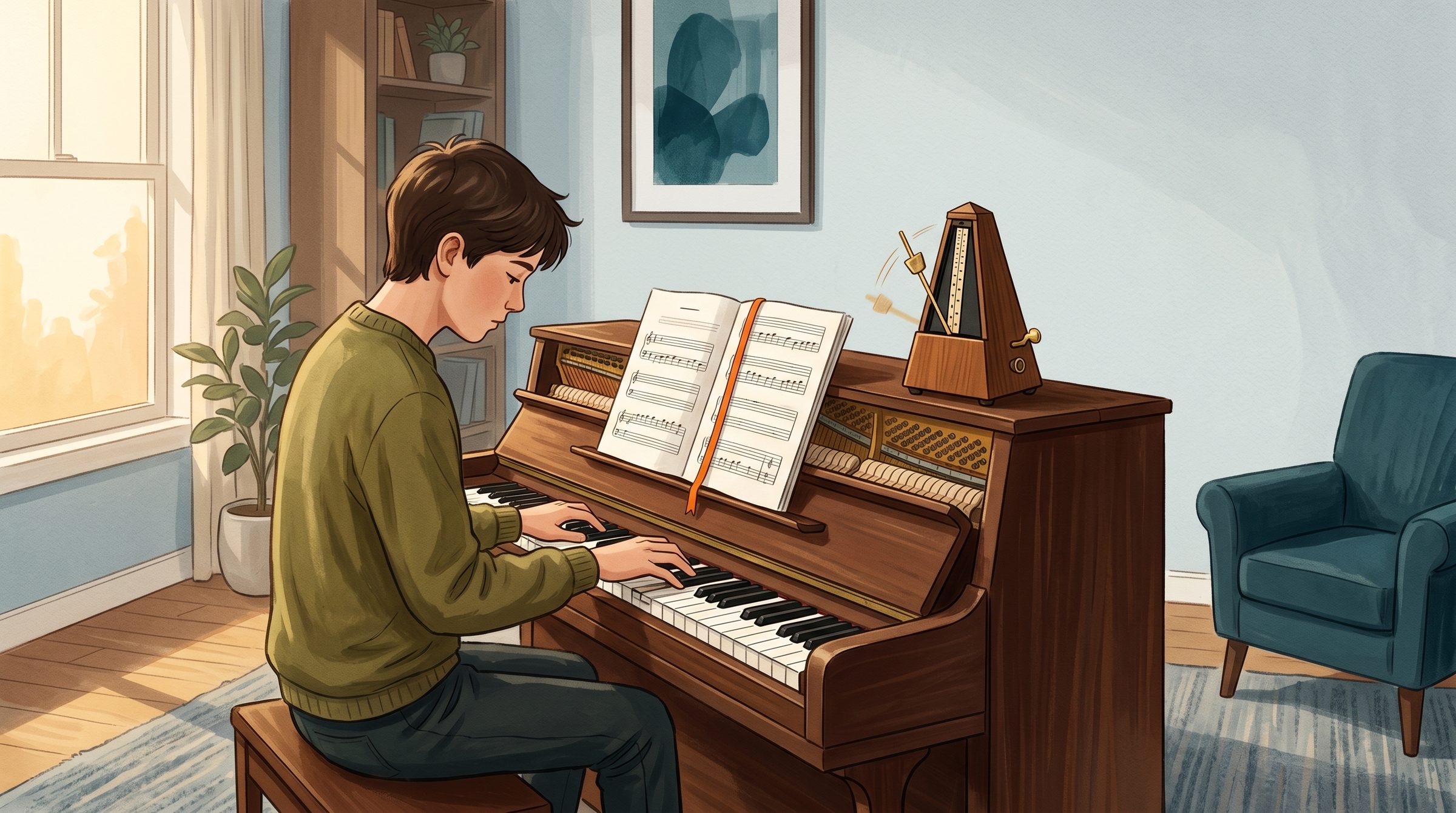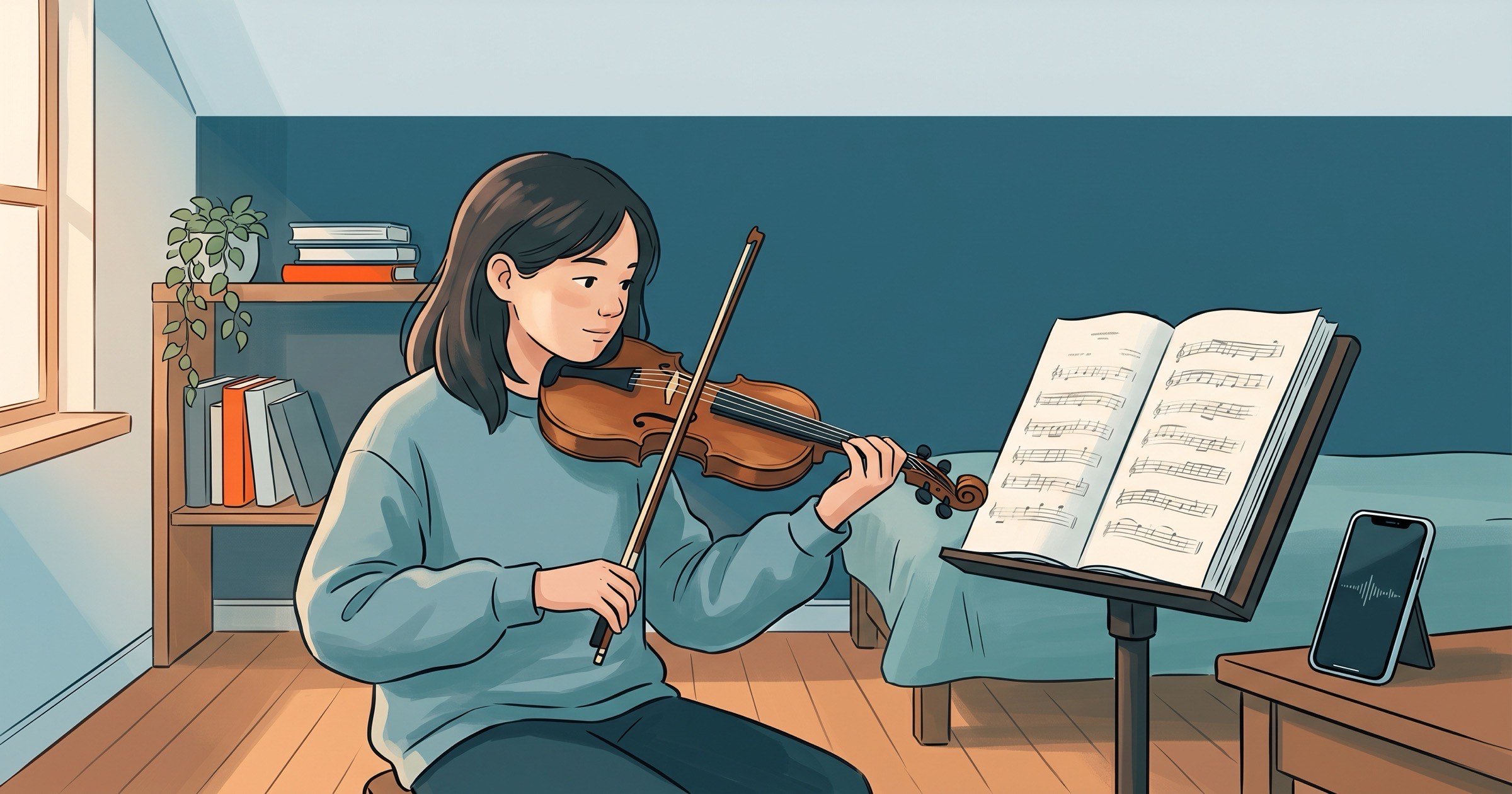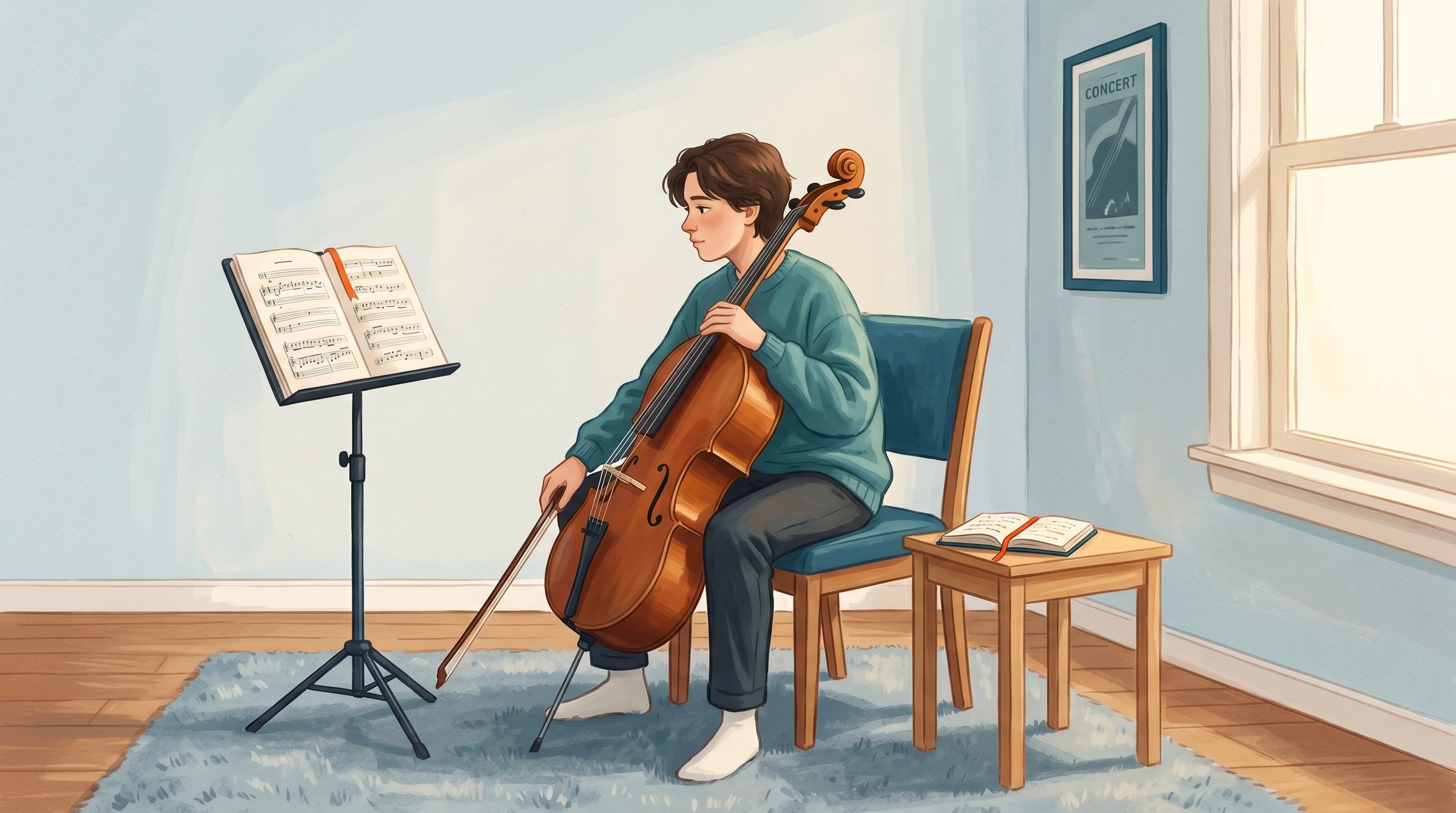
You have been working on the same piece for three months. Three months ago, every session produced visible progress. Now, the same passage that was eighty percent of the way there in February is still eighty percent of the way there in April. You are not practicing less. You are not practicing worse. You are stuck. A music practice plateau is one of the most universal frustrations in classical training — and the deliberate-practice research has a precise diagnosis for what is happening and what to do about it. The short version: the answer is almost never "practice more hours." It is almost always "change what the hours are doing."
What a Practice Plateau Actually Is
In skill-acquisition research, a plateau is a stable phase where performance no longer improves despite continued practice. Ericsson and colleagues describe the underlying mechanism in terms of automaticity: once a skill has been learned to a functional level, the brain stops devoting conscious attention to it, and the movement becomes automated. [1]
This is normally good news. Automaticity is what lets you play a piece while thinking about phrasing rather than fingering. The problem is that automated skills are hard to modify. Once a passage has been encoded into automatic motor patterns — including any flaws — improving it requires effortful intervention that the automatic part of practice cannot provide.
Ericsson's specific term for this is arrested development: the state where someone has reached an "acceptable" level and is now reinforcing it through routine practice instead of pushing against it. Ericsson notes that many amateurs (his examples are tennis players and golfers) reach an acceptable level and then hold it with minimal effort for years, even decades. The scary version of the plateau is the one where the student doesn't even notice it, because every session feels productive even though nothing is actually changing. [1]
The diagnostic question: do your sessions still feel effortful and uncertain, or have they started to feel comfortable? Comfortable sessions are usually plateau sessions. Real progress almost always feels harder than running through what you already know.
Why More Time Doesn't Fix It
The first instinct when stuck is to practice more — another hour today, weekend marathons, an extra session before lessons. The research does not back that instinct. Ericsson points out that length of experience is a weak correlate of job performance beyond the first two years, and that once a skill is automated, mere additional experience does not raise the level. [1]
Even the effortful, structured kind of practice explains less than you might expect. Macnamara's meta-analysis across domains (music, sports, games, education, professions) found that deliberate practice explained 21% of the variance in music performance, 26% in games and 18% in sports. Practice matters, but hours alone do not account for most of the difference between players. [4]
If you are on a plateau, adding hours to the same kind of practice is like adding more weight to a barbell when the form is wrong. You are not getting stronger; you are reinforcing the imperfection. Ericsson is direct: mindless playing strengthens the existing cognitive patterns rather than modifying them. The way out of a plateau is changing the patterns, not running more reps of them. [1]
The reframe that helps most: feeling stuck is information. It is your brain telling you that the current practice strategy has stopped producing learning. Adding time doesn't change the information. Changing the strategy does.
Interleaved Practice: A Plateau-Breaker Worth Trying
One plateau-breaker borrowed from motor-learning research is interleaved practice — practicing multiple different things in alternating order rather than working one task to completion. The opposite, called blocked practice, is what most students default to: play the hard passage twenty times in a row, move on, repeat tomorrow.
Stambaugh and Demorest summarise the motor-learning finding: in laboratory tasks, blocked practice wins when you test right after the session, while random or serial orders win when you test a day or more later. When they tried it with 19 seventh-grade clarinet and saxophone players in a single 18-minute session, though, they found no main effect of practice order on technical accuracy or musicality, either immediately or 24 hours later. Their study is small and preliminary, so treat interleaving as a sensible experiment for a stuck passage rather than a proven fix for musicians. [2]
A simple interleaved version of a stuck-passage session:
- Work on the difficult passage for three minutes.
- Switch to a contrasting passage from a different piece for three minutes.
- Return to the original passage for three minutes.
- Move to scales or technical work for three minutes.
- Back to the original passage.
The discomfort of switching is the point. Interleaving forces your brain to reload the context each time, which is harder in the moment but produces deeper learning. Blocked practice feels productive because each rep is easier than the last; interleaved practice feels harder because each return to the passage is a fresh attempt — which is exactly what builds retrieval strength.
Varied Practice and Structured Challenge
Beyond interleaving, the broader principle is varied practice: changing some dimension of the task each repetition rather than repeating it identically. For a stuck passage, this might mean:
- Playing it at a different tempo every iteration
- Playing it with different dynamics (whispered, then forte, then mezzo)
- Playing only the rhythm without pitches, then only pitches without rhythm
- Playing it backwards
- Playing it in a different key
- Playing while standing, then sitting, then walking
- Playing one note per click of the metronome at half tempo
Ericsson does not study these specific variations, but his account explains why they can help: automated skills are hard to adjust on purpose, and experts counteract automaticity by seeking out demanding tasks that force problem solving and stretch their performance. [1] Each variation makes you attend to the passage again instead of letting it run on autopilot.
Passarotto and colleagues' work on practice strategies adds the principle of task decomposition — breaking the difficult passage into smaller elements (just the rhythm, just the left hand, just one phrase) and rebuilding it. Both approaches have the same goal: re-introduce challenge into a passage that has flattened out into rote repetition.
Diagnosing Why You're Stuck
Before changing your practice, it helps to identify what kind of plateau you are on. The fixes differ:
Technical plateau — a specific physical skill has stopped improving. The fix is usually slower, more granular work on the underlying technique, often guided by the teacher.
Musical plateau — the technique works but the playing has stopped feeling alive. The fix is usually less practice on this piece and more listening — recordings, masterclasses, other students playing the same piece — to widen your sense of what is possible.
Repertoire plateau — you have been on the same piece for too long. The fix is sometimes to shelve it, work on something different for two or three weeks, and return with fresh ears.
Motivation plateau — practice has become a chore even though nothing is technically wrong. The fix is rarely more practice. It is often a different piece, a performance opportunity, or a teacher conversation about why the current goal feels hollow.
Hidden-mistake plateau — you have been practicing a small error so consistently that you no longer hear it, but it is preventing the passage from clicking. This is one of the hardest plateaus to self-diagnose, because the mistake has become part of how you remember the piece. Recording yourself and listening back helps here: Palese and Duke note that a recording lets you step outside your own perception while playing and check your first judgment of what happened. [3]
When to Get Help and When to Wait
Some plateaus resolve on their own with consistent deliberate practice over weeks. Others don't. The signal that you should escalate — to your teacher, or by changing your strategy more aggressively — is usually one of these:
- You have been working on the same passage with the same approach for more than three weeks with no measurable progress
- You can no longer hear the difference between a good attempt and a bad one (your monitoring has flattened)
- The piece has started producing physical tension or pain
- You have lost your internal model of what the passage should sound like
- Sessions feel routine — you cannot remember what was different about today's practice versus yesterday's
If any of those is true, the next session should not look like the last one. Talk to your teacher about whether to shelve the piece, change the approach, or get a fresh perspective on the passage.
For the slow-practice angle on stuck passages specifically, how to practice slowly is the deeper guide. For session structure that builds in plateau-breakers from the start, music practice tips for students covers ten habits that prevent most plateaus from forming.
The honest truth about plateaus: most of them are not lack-of-talent plateaus or lack-of-practice plateaus. They are strategy plateaus. The student is doing real work with the wrong strategy for the moment, and the fix is changing the strategy, not doubling down on the work. Tools like AIMU can help by making your week-over-week progress visible — when you cannot tell if you are stuck or improving, an external view of which passages are actually getting better turns "I feel stuck" into "this specific bar is stuck while these are improving," which is a much more actionable problem.
Plateaus are a feature of how skill acquisition works, not a sign that something is wrong with you. Breaking them is mostly a matter of practicing differently, not practicing more.
Further reading
- The Influence of Experience and Deliberate Practice on the Development of Superior Expert Performance (Ericsson, 2006, Cambridge Handbook of Expertise, ch. 38)
- Effects of Practice Schedule on Wind Instrument Performance (Stambaugh & Demorest, 2010)
- Thinking Time in Music Practice (Palese & Duke, 2022, Update 41(1), 34–44)
- Deliberate Practice and Performance in Music, Games, Sports, Education, and Professions: A Meta-Analysis (Macnamara, Hambrick & Oswald, 2014)