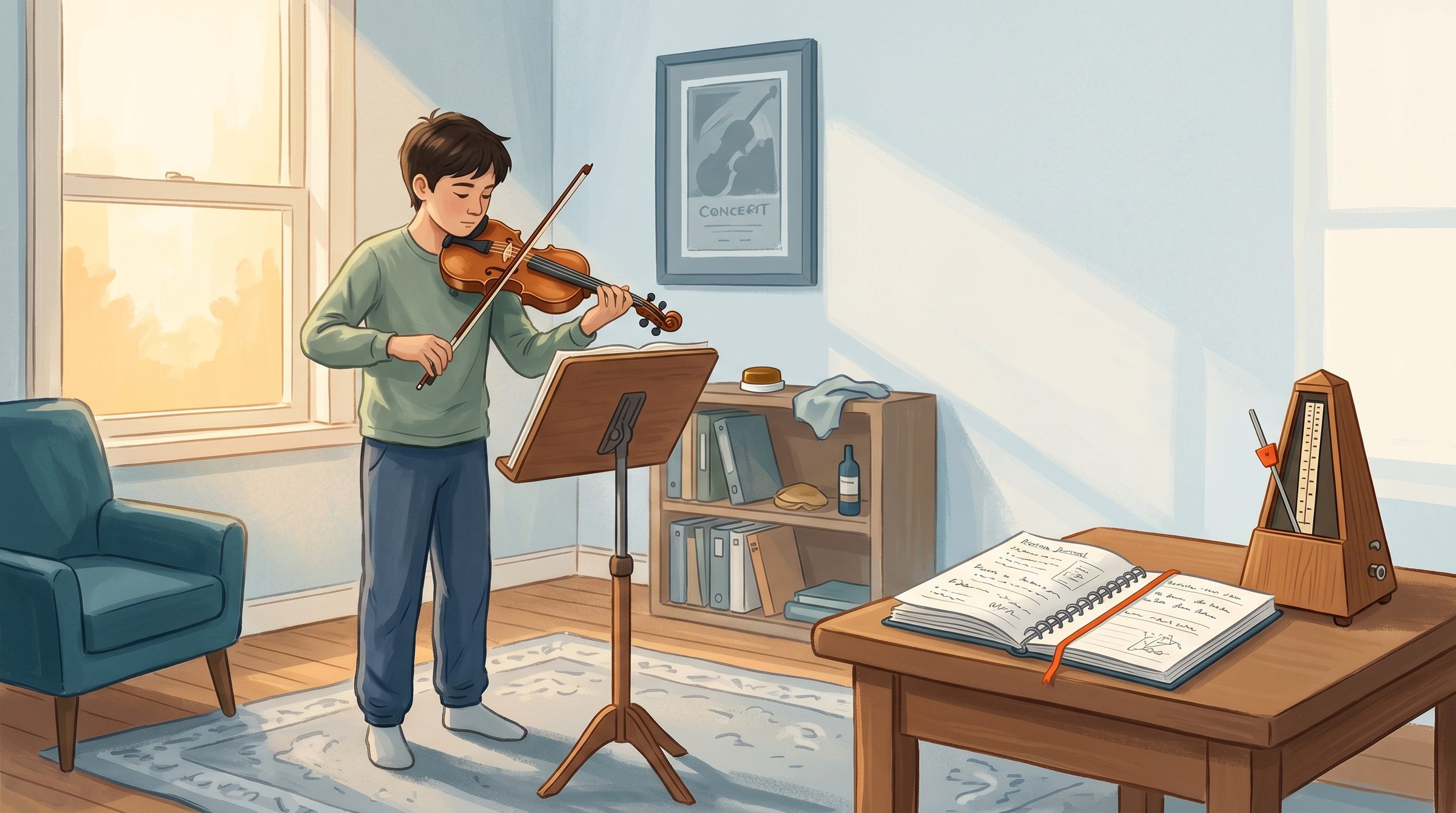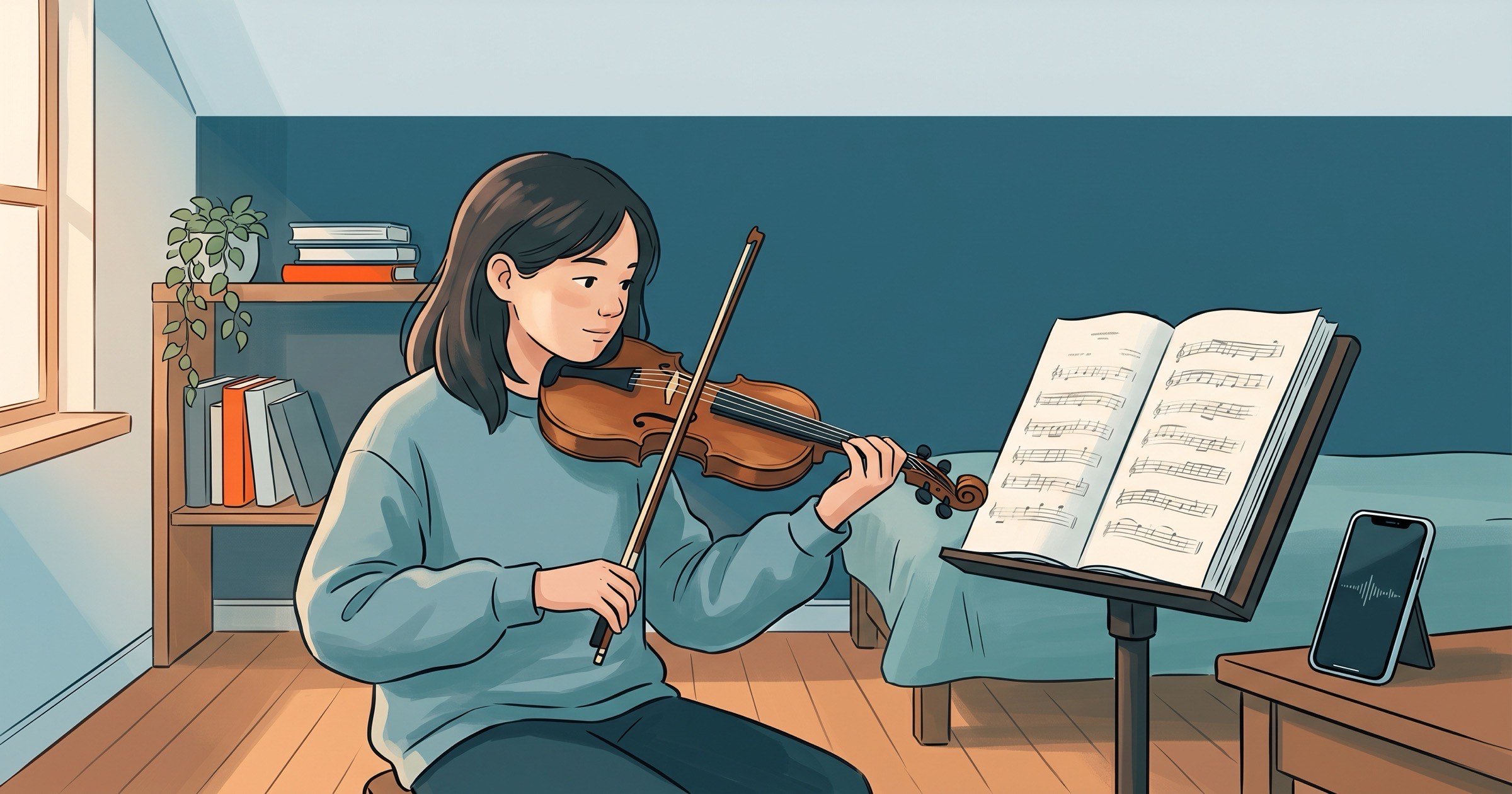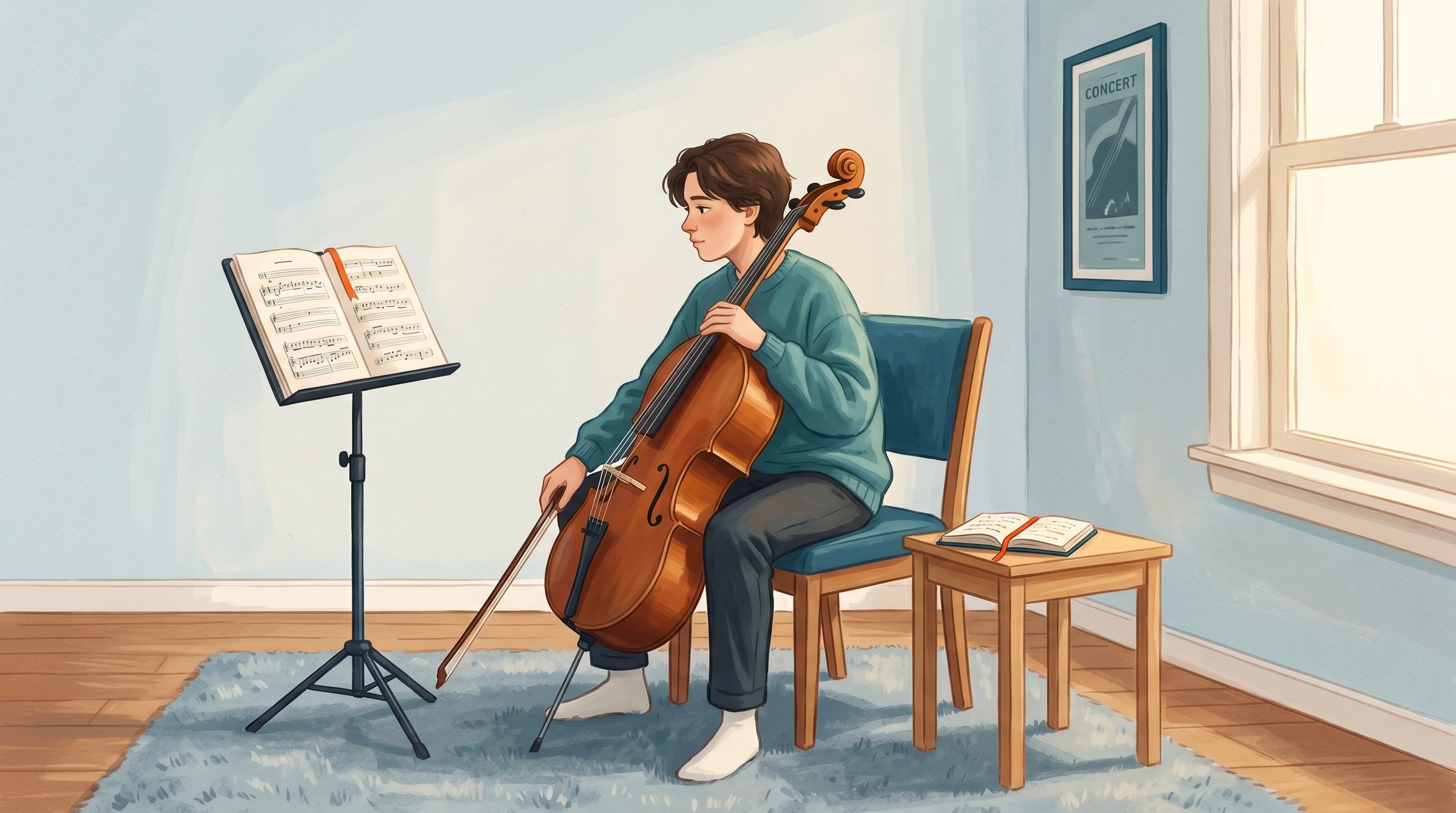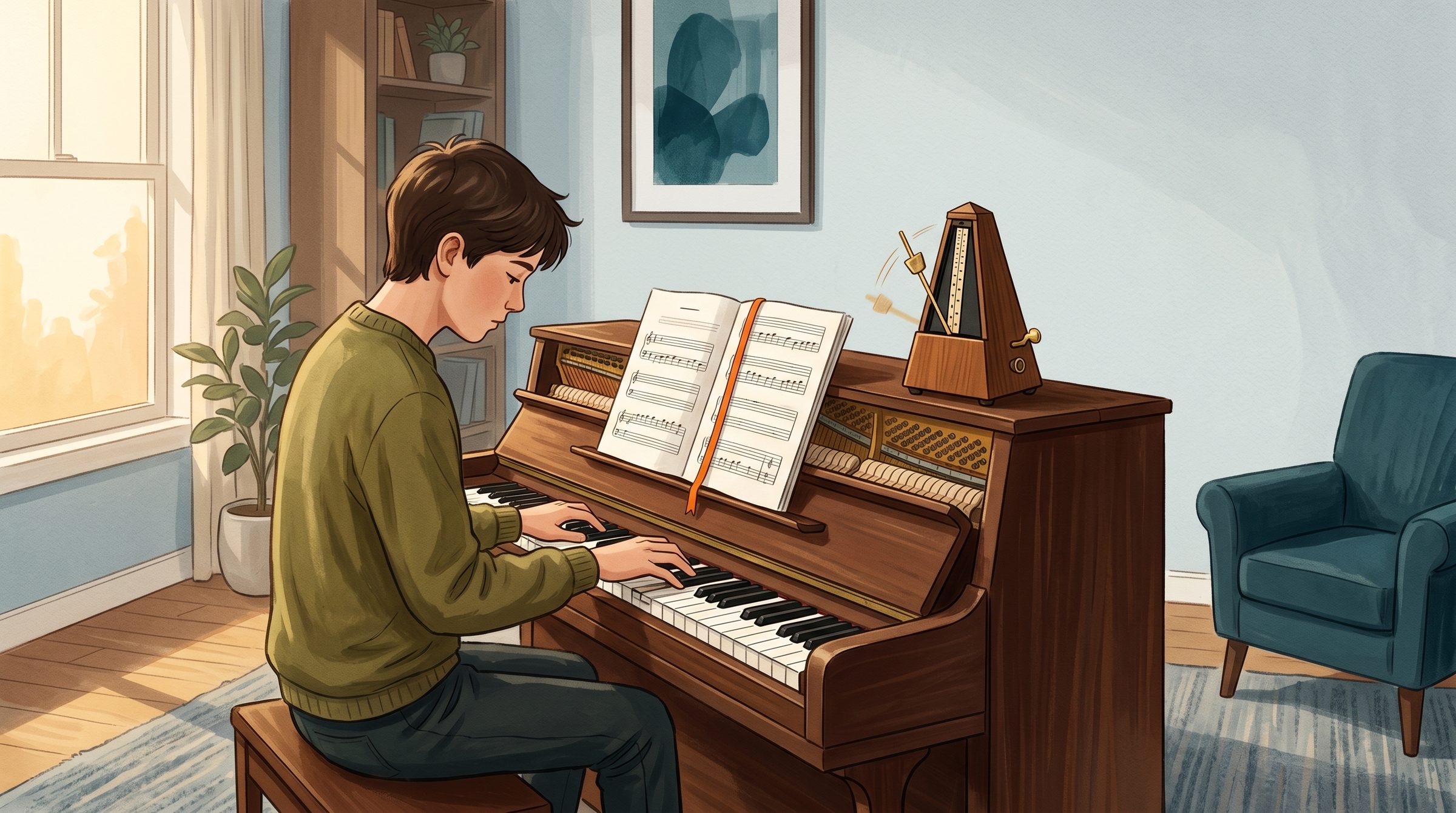
Every teacher tells students to practice slowly. Almost no student actually does it for long. Slow practice feels wrong in a way that's hard to explain — you can clearly play the piece faster, so why force yourself to crawl through it? The research on motor learning has a clear answer, and it explains why the students who master "how to practice slowly" tend to be the same students who eventually play faster, cleaner, and more reliably than the ones who don't. The shortcut you think you are taking by playing at full speed is the long way around.
Why Slow Practice Works: What's Happening in Your Brain
When you play a passage, your brain encodes whatever just happened — including every wrong note, sloppy rhythm, and tense shoulder. Motor learning research shows that practice strengthens the patterns you actually performed, not the ones you intended to perform. Play a passage three times with the wrong fingering at full speed, and your brain has now learned the wrong fingering three times.
Slowing down breaks that loop. At a slower tempo, your brain has time to process auditory feedback (what it sounds like) and physical sensations (what it feels like) in real time. Palese and Duke argue that effective music learning requires this kind of immediate comparison, trial by trial, between what you intended and what came out. The noticing matters as much as the playing. [2]
Ericsson's work on deliberate practice describes the risk more bluntly: once a movement becomes automatic, you lose conscious control over it and can no longer make intentional adjustments, and more repetition stops producing improvement. Slowing down is one way to keep a passage under conscious control while you still need to change it. [1]
The intuition that slow practice is "wasting time" assumes there is a faster way to practice the right thing. There isn't one. Fast practice teaches your hands what you actually played; slow practice teaches your hands what you meant to play.
How Slow Is Slow Enough
There is a useful test for whether your slow tempo is actually slow enough: at this tempo, can you play the passage perfectly, every time, with no mistakes?
If the answer is "yes, easily" — you are practicing at the right slow tempo. If the answer is "almost" — you are not slow enough. Drop the tempo more. If the answer is "no, even at this tempo it's hard" — you are still too fast. Drop it again.
This sounds obvious. In practice, students consistently underestimate how slow they need to go for hard passages. Palese and Duke point out that noticing mismatches between intention and outcome takes attention, and that players still struggling to control the movement often have none left for feedback. Their study didn't test tempo, but the practical rule follows: if you cannot monitor what you are doing at the chosen tempo, you have not slowed down enough. [2]
For a difficult passage, that often means quarter = 40 or even 30 — speeds that feel almost embarrassingly slow. They are also the speeds at which actual learning happens.
The Build-Up: How to Get the Tempo Back
Slow practice isn't the goal. Performance tempo is the goal. The bridge between them is how you build the tempo back up — and most students rush this step, which is how they end up back where they started.
A reliable build-up pattern, common in teaching studios:
- Find the slowest tempo at which you can play the passage cleanly — every note correct, no tension, no rush. This is your base.
- Play it cleanly three times in a row at the base tempo before increasing.
- Increase by a small step — usually 4 to 8 BPM, not 20.
- If the new tempo is clean three times, increase again. If it isn't, stay there until it is.
- If you make a mistake at any tempo, drop back two steps — not one. Going back further is faster than trying to push through.
The exact numbers here (three clean repetitions, 4 to 8 BPM, two steps back) are rules of thumb from teaching practice, not figures from a study. What matters is the principle: each tempo step should be small enough that you stay in control.
This is also why a metronome is essential for slow practice. Your sense of tempo is unreliable when you are concentrating on technique. The metronome is the thing that keeps you honest.
Why Slow Practice Feels Wrong (and Why That's the Point)
Slow practice triggers a specific psychological resistance. The piece you are working on has a real tempo; playing it slower feels like you are insulting it, or wasting time, or somehow not really practicing. This feeling is wrong, and recognizing it as a feeling rather than a fact is half of being able to practice slowly at all.
The discomfort is partly cognitive. At slow tempo you can hear your own playing in detail you cannot hear at full speed — every imperfect intonation, every tense phrase, every awkward shift. That information is uncomfortable to hold. It is also exactly the information you need in order to improve. Ericsson describes deliberate practice as work on a specific weakness that requires full attention and concentration, and that is why nobody can sustain it for long. Playing through a piece on autopilot doesn't qualify. [1]
If slow practice feels easy, you are probably not slowing down enough. Real slow practice feels somewhere between meditation and tedium — and it is also the part of practice that reliably moves the needle.
When to Slow Down (and When Not To)
Slow practice is not for everything. Run-throughs of pieces you already play well, sight-reading of new repertoire, performance simulations — these all need to happen at or near tempo. Slow practice is for the specific moments where something is not yet right.
The cleanest rule:
- Slow down for any passage that is not currently clean at full speed. Stay there until it is clean at slow tempo, then build back up.
- Slow down for new pieces in the early learning phase, before fingering and rhythm are settled.
- Slow down for technical challenges — fast runs, awkward shifts, complex coordination — independently of the rest of the piece.
- Don't slow down for run-throughs of pieces you already know. That's a different kind of practice, focused on stamina, musicality, and performance flow.
A typical practice session combines both: most of the session is slow, focused work on specific problems; the last ten minutes are full-tempo run-throughs of pieces that already work, to keep them in your fingers.
Common Slow-Practice Mistakes
A few patterns that look like slow practice but aren't producing the benefits:
Practicing slowly without a metronome. Without an external reference, your "slow tempo" is usually just slightly slower than your normal tempo, and it drifts faster as you get into the passage. The metronome is the thing that makes slow actually slow.
Slowing down to the easy parts but not the hard parts. Students often drop the tempo on a tricky passage but speed up again the moment they are out of it. The whole point is to slow down where it is hard, not where it is comfortable.
Building tempo too quickly. If you go from quarter = 60 to 80 in one step, you have skipped the encoding of every tempo in between, and the muscle memory at 80 has nothing to land on. Go up by 4 to 8 BPM at a time.
Treating slow practice as warm-up. Slow practice is the work, not the prelude to it. If you are spending five minutes slow then thirty minutes fast, you are mostly doing fast practice — including all the mistake-encoding it produces.
If you are stuck on a specific passage and it has been weeks without progress, see how to break a music practice plateau for the broader strategy. If slow practice is just one piece of your overall session structure, music practice tips for students covers the full toolkit.
The thing slow practice teaches is patience for the work that is actually changing your playing. Most of what improves your playing happens at tempos no audience will ever hear. Tools like AIMU help here by visually showing which passages improved across the week — which makes the slow, invisible work of slow practice concrete in a way the practice itself rarely feels. Speed is what you perform. Slow is where the speed is built.