You can play your piece perfectly with the score in front of you. The teacher closes the book at the next lesson, and suddenly you cannot get past bar four. This is the most common memorization failure, and it is not because your memory is bad. It is because you have been relying on only one of the four kinds of memory that classical musicians use to learn a piece by heart. Learning how to memorize music well means using all four — and the research on chunking, retrieval, and spaced practice has clearer guidance than most students ever get.
The Four Kinds of Memory You Need (Not Just One)
Classical musicians who memorize reliably are using four distinct memory systems, often without naming them. When one fails on stage, the others hold the piece up. Most students rely heavily on just one — usually muscle memory — which is exactly why their memorization collapses under pressure.
Auditory memory is the mental sound of the piece. You can hear it in your head before you play it. Skilled musicians use auditory imagery to set a clear target for each note before producing it. Palese and Duke, drawing on motor-learning research, describe effective practice as forming a clear intention (often an auditory image) before each attempt and then comparing the outcome against it. Without that target, you are reacting rather than aiming. [1]
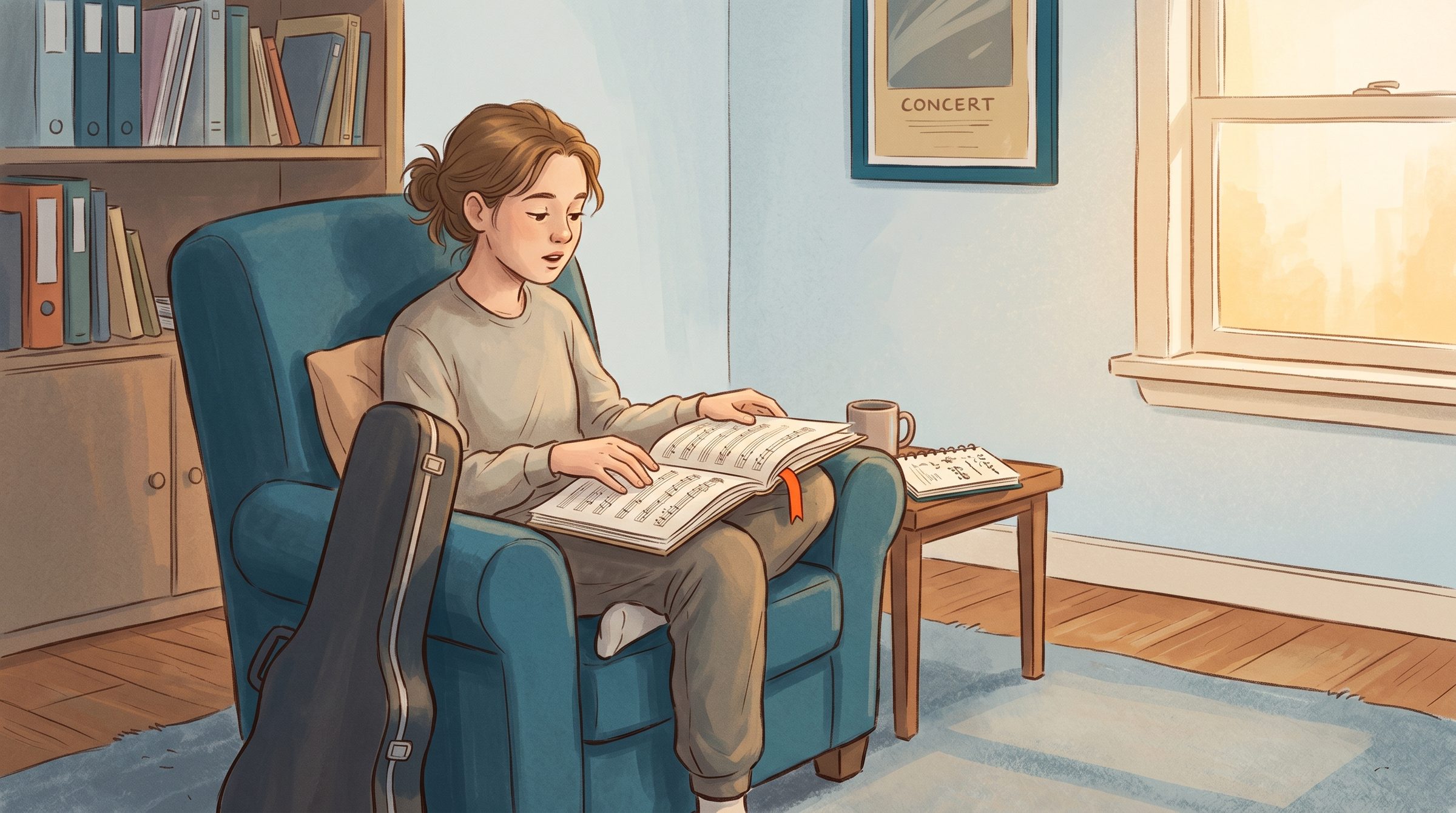
Visual memory is the image of the score in your mind — the shape of the page, the grouping of phrases, the location of difficult passages. This is what kicks in when you blank: a mental snapshot of the score that helps you find your place again.
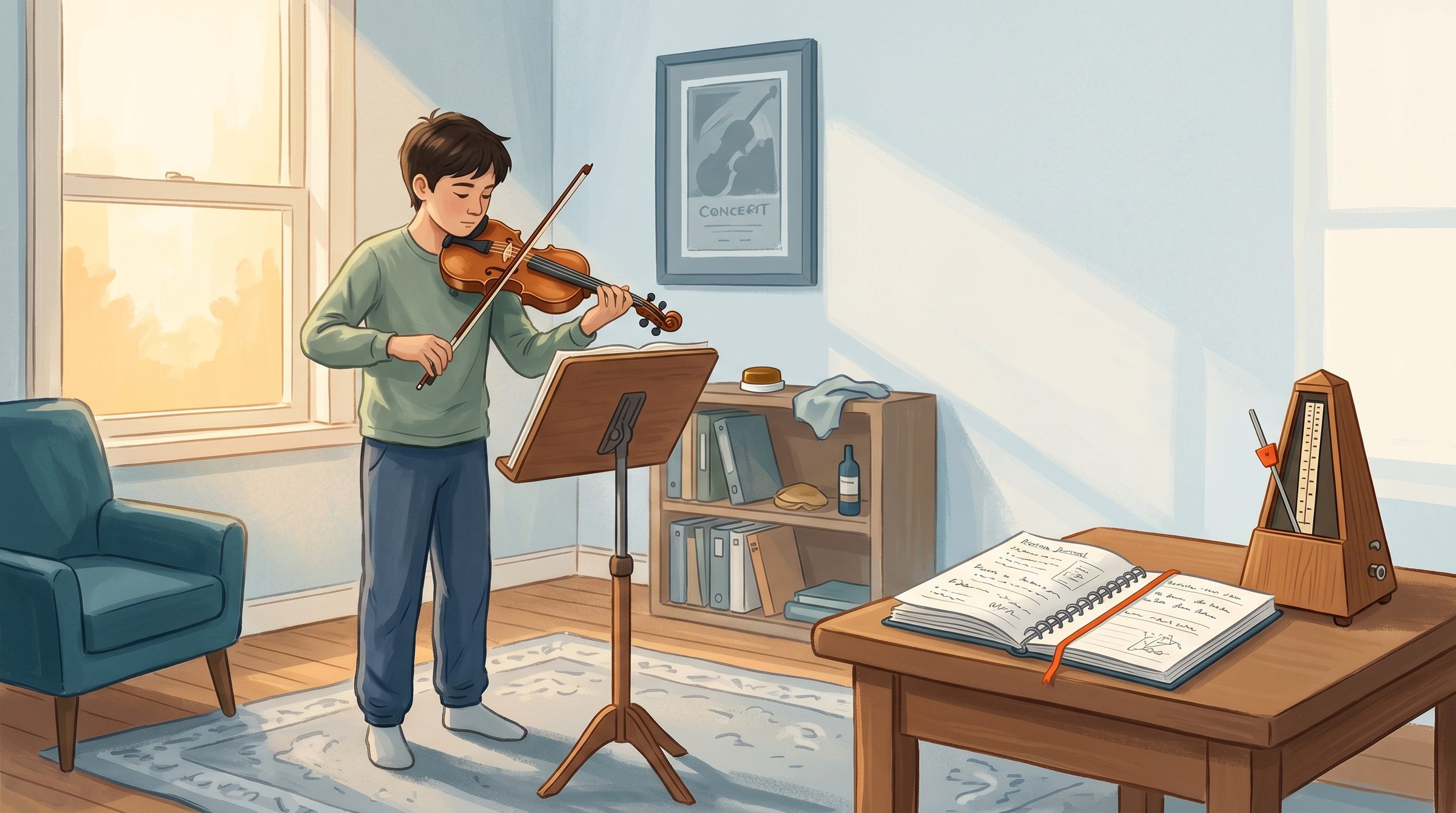
Kinesthetic (muscle) memory is what your hands know — the physical sequence of movements. This is the easiest to develop and the least reliable on its own. It works fine in your practice room and fails dramatically the first time you play in a different acoustic, on a different instrument, or in front of an audience.
Analytical memory is your understanding of what the music is doing — the harmonic structure, the form, the relationship between sections. Ericsson's review of expert performance describes experts building "mental representations" that let them monitor and adjust their performance as they play. The piece is no longer just a sequence; it is a structure you can navigate. [2]
Reliable memorization layers all four. If you can sing the piece (auditory), see the page (visual), play the gestures away from the score (kinesthetic), and explain the harmony (analytical), you have something that holds up under stage pressure.
Chunking: Stop Memorizing Notes, Start Memorizing Phrases
One of the oldest findings in cognitive psychology is that working memory holds only a few items at once — but the items can be small or large. Memorizing a hundred individual notes is impossible. Memorizing twenty four-note motives, or eight phrases, or four sections, is straightforward.
Ericsson cites Simon and Chase's chess research, which argued that masters must have acquired some 50,000 "chunks" or patterns that let them retrieve suitable moves from memory. The same idea, storing meaningful units instead of single elements, is a good way to think about how a violinist memorizes a Bach partita without going insane. [2]
Practical translation: when you memorize, don't try to learn note by note. Identify the natural units in the music — phrases, motives, sequences, repetitions — and memorize those as single objects. A motive that appears five times in the piece should be learned once, not five times. The structure does the heavy lifting that brute-force repetition cannot.
Spaced Practice: Why Forgetting a Little Helps You Remember More
The intuitive way to memorize is to keep playing the piece until it sticks. The intuitive way is wrong. Spaced practice — distributing your memorization across multiple shorter sessions over days — tends to produce better long-term retention than the same total time done in one block.
Passarotto and colleagues summarize research showing a retention advantage for distributed practice, citing Rubin-Rabson's 1940 study of memorizing piano music among others, and suggest the benefit may come from memory consolidation during rest and sleep. [3]
If consolidation during sleep and rest is part of the mechanism, it is a process you cannot rush by practicing more at once. Coming back to a piece the next day and finding you still remember most of it is what burns the memory in deeper. The slight forgetting between sessions is not a bug; it is what makes the next session productive.
Practical translation: memorize a section, sleep on it, retrieve it the next day. Don't memorize the whole piece in one heroic session — much of it will not survive the week.
Retrieval Practice: Test Yourself Without the Score
The single most under-used memorization technique is retrieval — actively pulling the music out of memory rather than passively reviewing it. Reading the score and playing along is review. Closing the score and trying to play is retrieval. In our experience, the two produce very different results.
Retrieval forces your brain to rely on internal mental representations, which is exactly the skill you need on stage. It also reveals exactly which parts of the piece are not actually memorized — the bars where you stumble are the parts to work on next. Palese and Duke's review of motor-learning research treats this comparison between intention and outcome as a core mechanism of skill learning. [1]
A reliable retrieval practice cycle:
- Study a section with the score for ten minutes.
- Close the score and try to play it from memory.
- Note where you got stuck — those are the spots to work on next.
- Open the score, fix those specific spots.
- Close the score and try again.
The discomfort of trying to retrieve without the score is the discomfort of actually memorizing. If it feels easy, you are reviewing, not memorizing.
Mental Practice: Memorizing Without Touching the Instrument
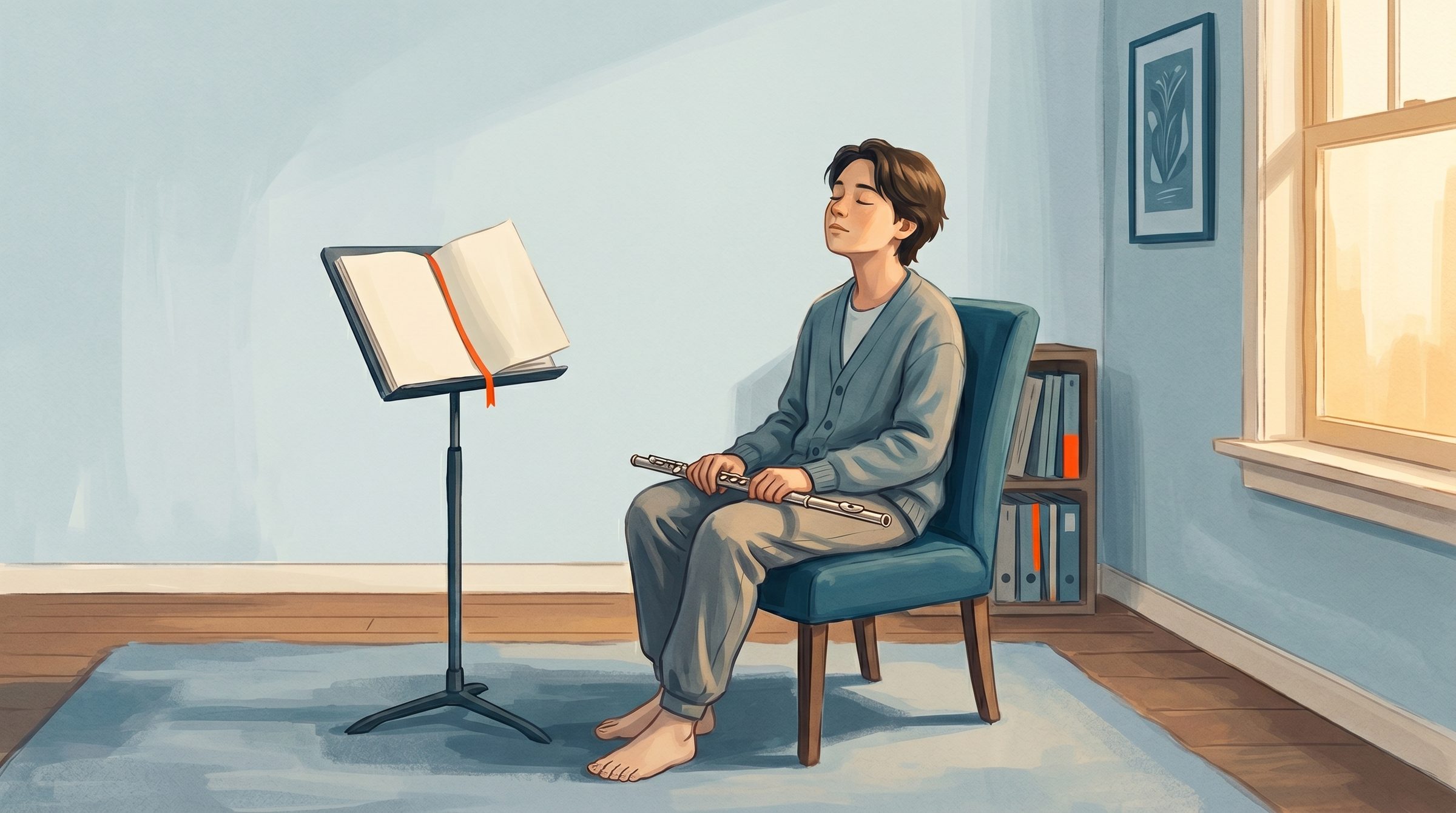
Mental practice — running through the piece in your head, away from the instrument — is a real research-backed technique, not a hack. Palese and Duke cite Driskell and colleagues (1994) and Magill and Anderson (2017) in defining mental practice as cognitive rehearsal of a skill without physical movement, and note that several music studies, including Ross (1985) and Coffman (1990), have shown benefits of mental practice combined with physical practice. [1]
They also point out its limit: imagined playing gives you no feedback from real sound, so it works best alongside the instrument, not instead of it. In return, it trains the auditory and analytical memory systems most directly, since you have to imagine the sound and structure rather than rely on muscle memory.
Practical translation: review the piece in your head on the bus, before sleep, while waiting somewhere — anywhere your hands cannot reach the instrument. This is also the only way to practice when injured, traveling, or otherwise instrument-less.
For a full guide to mental practice as a standalone technique, see mental practice for music students. For the broader practice-session structure that makes memorization stick, music practice tips for students covers ten research-backed habits including the ones used here.
Putting It All Together: A Memorization Workflow That Holds Up
Combining the four memory types with chunking, spacing, and retrieval gives a workflow that actually works under performance pressure:
- Analyze first. Sketch the structure on paper before learning any notes — sections, motives, harmonic progression. (Builds analytical memory and creates chunks.)
- Sing or hum the piece away from the instrument until you can hear it in your head. (Builds auditory memory.)
- Memorize one chunk per session. A phrase, a motive, a section — never more than your concentration allows. Stop while you are still in focus, not after fatigue.
- End each session with retrieval. Close the score, try to play what you just learned. Note the gaps.
- Sleep, then test again the next day. Whatever survived overnight is the foundation. Whatever didn't is the next session's work.
- Mental rehearse between sessions. Run the piece in your head when you cannot play.
- Build up. Add chunks across days; combine adjacent chunks into longer sections; eventually link sections into the whole piece.
- Practice retrieval in different contexts — different rooms, sitting versus standing, with and without distractions. Memory that only works in your practice room is not memory; it is location-bound muscle habit.
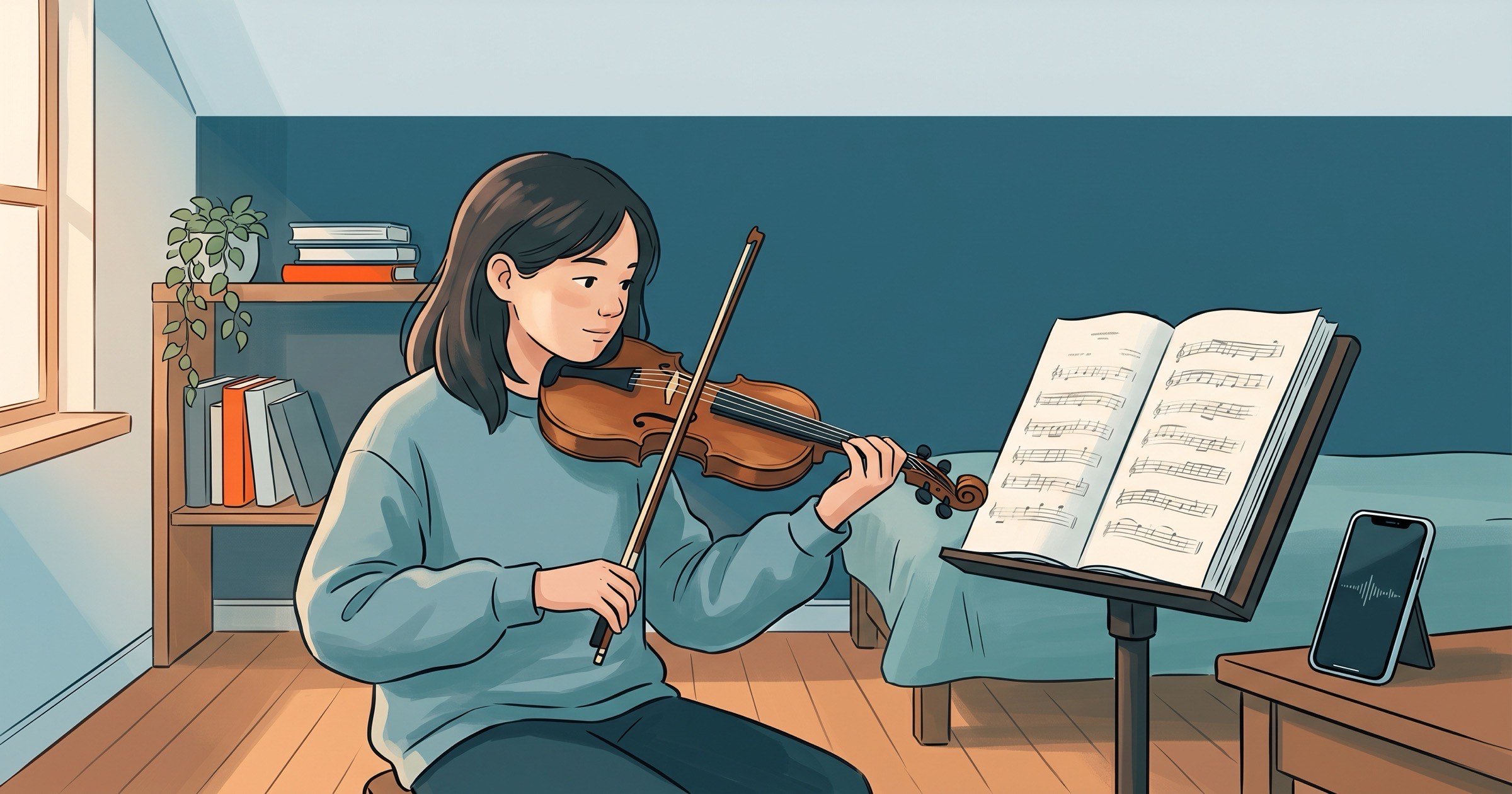
A tool like AIMU can help with the retrieval step by listening as you play from memory and showing you exactly which passages drifted off the score — which is the gap between what you thought you remembered and what you actually played. Used alongside the techniques above, it makes the invisible work of memorization concrete.
The thing memorization actually requires is structure: of the music, of your sessions, of the cycle between learning and retrieving. The students who memorize reliably are not the ones with better memory — they are the ones whose practice has structure built into it from the beginning.
Further reading
- Thinking Time in Music Practice (Palese & Duke, 2022)
- The Influence of Experience and Deliberate Practice on the Development of Superior Expert Performance (Ericsson, 2006)
- Deliberate Practice in Music: Development and Psychometric Validation of a Standardized Measurement Instrument (Passarotto et al., 2022)
- Deliberate Practice and Performance in Music, Games, Sports, Education, and Professions: A Meta-Analysis (Macnamara, Hambrick & Oswald, 2014)