You have an audition in three weeks. You also have school, a sprained finger that needs a day off the violin, a long bus ride home, and a noisy apartment where serious practice at 10 PM is not an option. Most students treat all of this as practice time you have lost. The motor learning research says it isn't — at least not necessarily. Mental practice for music — running the piece in your head, away from the instrument — is a real, evidence-backed technique that can recover much of the practice you would otherwise miss, and in some cases adds something you can't get from physical practice at all.
What Mental Practice Actually Is
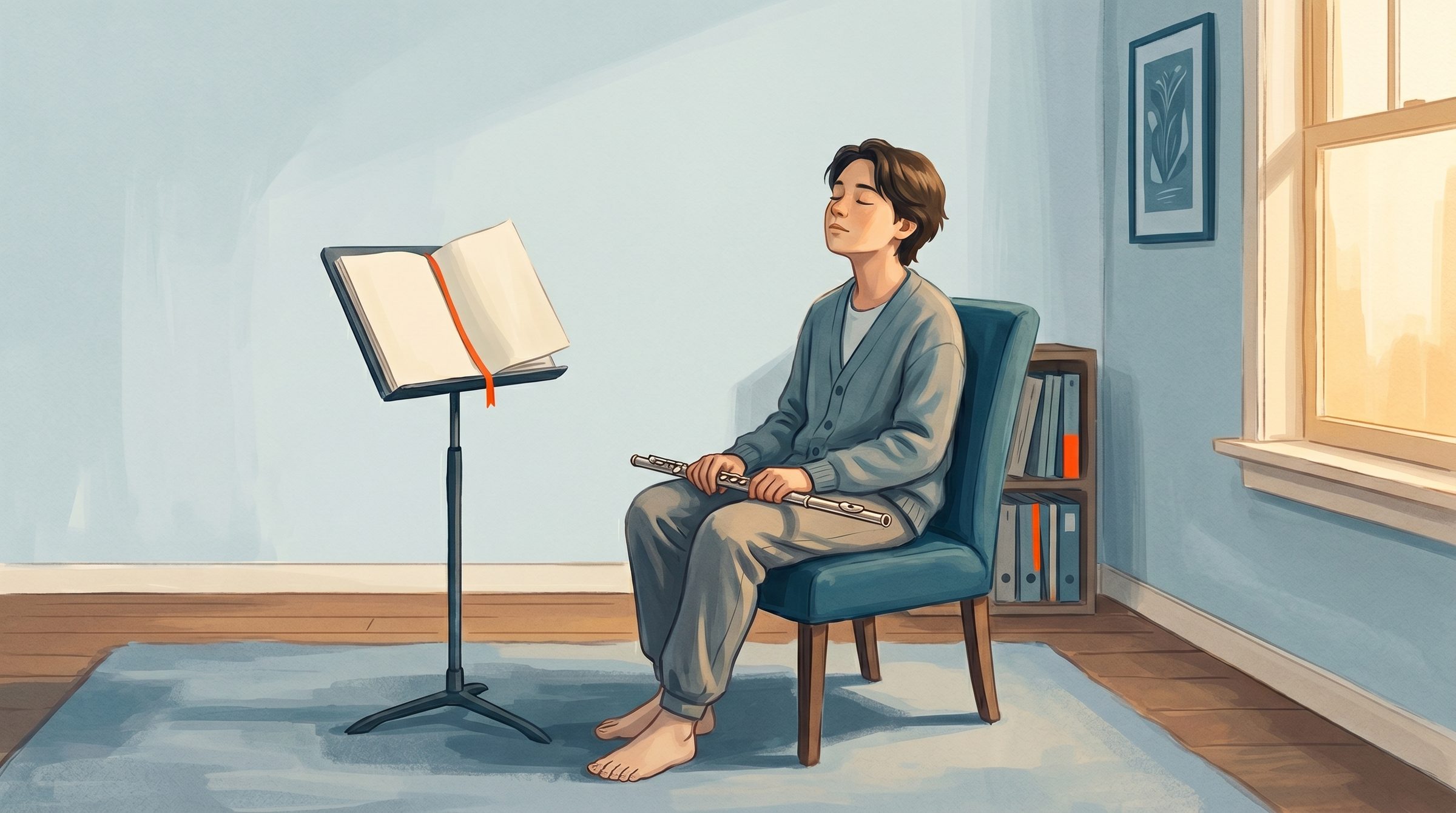
Mental practice — sometimes called cognitive rehearsal or motor imagery — is the deliberate, structured rehearsal of a task in your head, without overt physical movement. Driskell and colleagues' 1994 meta-analysis defined it as the cognitive rehearsal of a task in the absence of overt motor performance, and Magill and Anderson's motor learning textbook characterizes it the same way: thinking about the cognitive or procedural aspects of a motor skill, or imagining the performance of it visually or kinesthetically. [1]
This is not visualization-as-relaxation, and it is not "thinking about" the piece in a vague way. Mental practice means actively imagining the music with as much specificity as you would play it: the sound of each note, the physical sensation of producing it, the timing, the dynamics, the phrasing. Palese and Duke's study of thinking time in practice argues for this kind of clear, specific internal target: musicians get the most from practice when each attempt starts from a vivid image of the intended result, and they notice where the actual result falls short. [1]
The catch: it is harder than physical practice, not easier. Maintaining vivid auditory and kinesthetic imagery for ten minutes takes real concentration, and most students who try it for the first time find their attention drifting within a minute. Like physical practice, mental practice is a skill that develops with use.
Does It Actually Work? What the Research Says
Yes, with caveats. The evidence on mental practice across domains — sports, surgery, music, complex motor skills — is consistent: mental practice produces real improvements, but it is not a complete substitute for physical practice. Driskell's meta-analysis found that the effect is real and meaningful, especially for cognitive components of a task (sequence, timing, structure). Physical components like fine motor execution still benefit most from actual playing.
For music specifically, studies including Ross (1985) and Coffman (1990) found benefits from mental practice combined with physical practice. [1] That is the most useful practical point: mental practice adds to your physical practice, and it gives you access to practice time you didn't have otherwise.
Ericsson's review of deliberate practice describes how experts keep improving: they refine the mental representations they use to plan, monitor, and evaluate their performance, instead of letting it run on autopilot. [2] Focused mental practice works on those same representations, planning the sound and checking it against your intentions, without the mechanical wear and the room-noise constraints.
What it cannot do: build muscle memory for the physical mechanics of playing in any direct way, fix problems that are purely mechanical, or replace the auditory feedback of actually producing sound. Mental practice is a complement to physical practice, not a replacement.
The Three Modes of Mental Practice
Different kinds of mental practice work different parts of your musicianship. The most useful framing breaks them into three modes:
Auditory imagery is hearing the piece in your head. Not just the melody — the full texture, the dynamics, the room, the phrasing. In Palese and Duke's study, the more experienced musicians took at least as long to imagine an ideal performance of a passage as to play it, while less experienced players rushed the imagining. [1] The same internal model can be rehearsed without an instrument, and the clearer your auditory image, the more precisely you can hear where your playing falls short of it.
Motor imagery is feeling the physical sensation of playing — the bow contact, the breath, the finger placement, the weight of the embouchure. This is the closest mental analog to actual physical practice, and it activates similar brain regions to the physical movement itself. Motor imagery is most useful for passages where the physical mechanics are the bottleneck.
Analytical mental practice is working through the structure of the piece — phrase boundaries, harmonic shifts, formal divisions, recurring motives. This is closer to studying a score than to imagining a performance, and it builds the analytical memory that holds memorization together when other systems fail. For broader memorization work, how to memorize music goes deeper on how the four memory systems combine.
A complete mental practice session usually combines all three: hearing the music, feeling the playing, and understanding the structure. Most students naturally do one of these and ignore the other two.
When Mental Practice Beats Physical Practice
For most situations, physical practice is more effective per minute than mental practice. There are specific cases where the reverse is true:
When you're injured. A sprained finger, jaw fatigue, a strained shoulder — any condition where playing risks making the injury worse. Mental practice keeps your fluency and memorization while you heal, and protects the physical recovery.
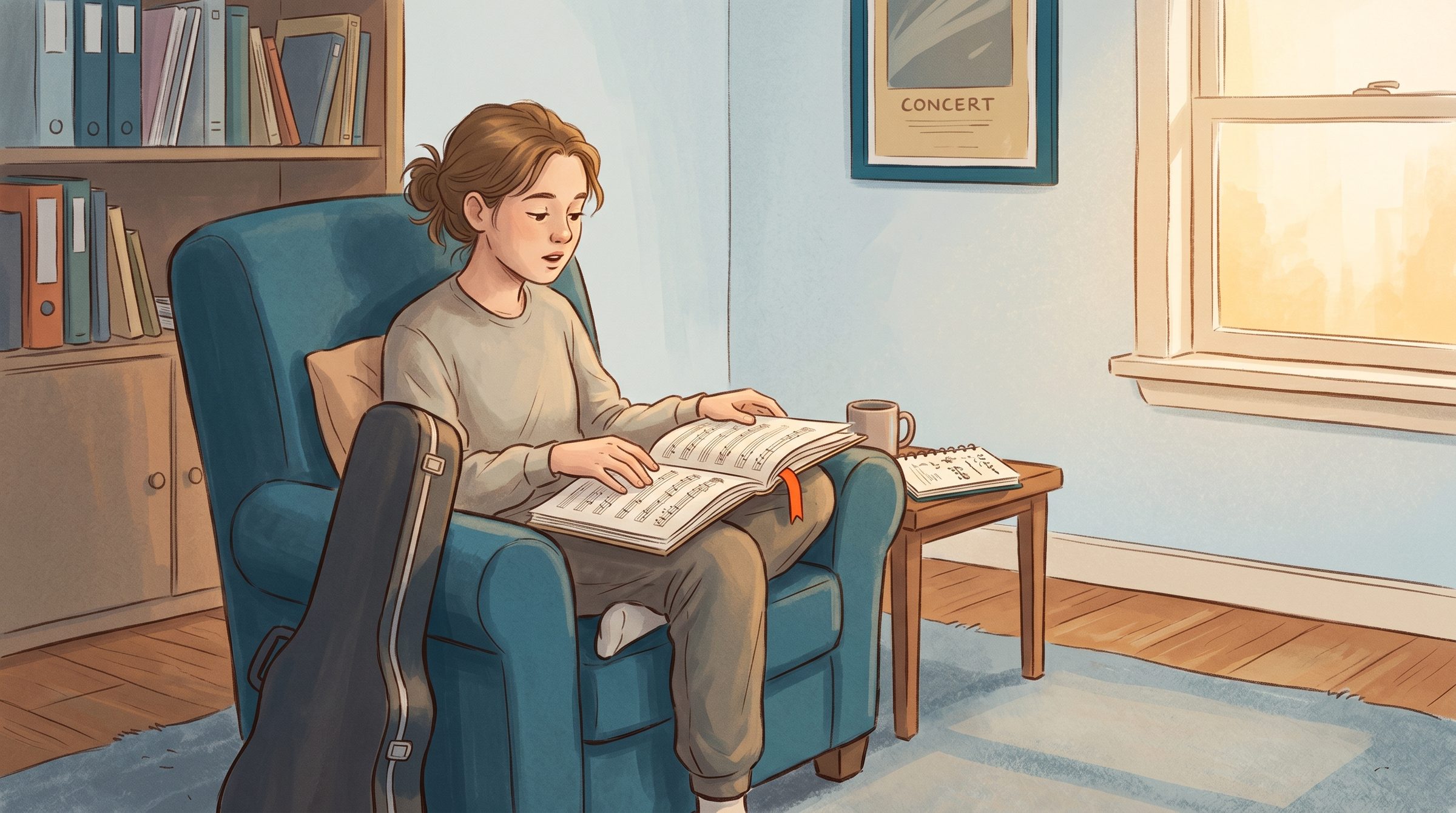
When the room is wrong. Late night, thin walls, no instrument access. Mental practice is silent and infinite. The bus, a waiting room, before sleep — all valid practice contexts.
When you're over-tired. Past the cognitive cliff where physical practice is just reinforcing whatever you happen to play. Mental practice with full concentration in a different mode can produce real learning when fatigued physical practice would actually hurt.
Right before performance. Many performers do their final pass of a piece mentally, not physically. The auditory and analytical pass is what stage performance actually relies on, and the last hour of physical rehearsal often introduces new problems through fatigue.
For passages that are cognitively hard, not physically hard. A complex rhythm, an unfamiliar key signature, an awkward formal structure. Sometimes the bottleneck is your understanding of the music, not your hands — and mental practice addresses that more directly than playing it again.
How to Actually Do It (Without Drifting)
The biggest obstacle to mental practice is attention drift — five seconds in, your mind has wandered to dinner. A few practical techniques:
- Start short. One minute of vivid mental practice is more useful than ten minutes of half-attention. Build duration the way you'd build physical stamina.
- Have the score handy. Glancing at the page when you lose your place is fine; pretending you don't need to look is how attention spirals.
- Move with the music in your head. Light fingering motions, breathing as if you were playing — the physical engagement keeps the imagery anchored without using the instrument.
- Pick a specific goal per session. "Run the exposition mentally with attention to the dynamics" works. "Mental practice the piece" doesn't.
- Compare immediately. After mental practice, play the same passage on the instrument. The gap between what you imagined and what came out is the most useful feedback in the technique.
- Use it as a cool-down. Five minutes of mental practice at the end of a physical session can lock in what you just worked on, since memory consolidation continues during rest.
Ericsson's review notes that deliberate practice demands a level of concentration people can sustain only for limited periods, and that elite musicians report this as the main limit on how much they can practice. Mental practice is unforgiving about this — without an instrument to keep you busy, the moment you stop concentrating, you stop practicing. That intolerance for drifting is what makes it train attention so directly. [2]
What to Practice Mentally vs. on the Instrument
A useful split:
Mental practice handles:
- Memorization (especially analytical memory)
- Phrasing decisions and musical interpretation
- Score study before sight-reading
- Recovery and warm-up before performance
- Practice during travel, illness, or noise constraints
- Emergency review the day of an audition
Physical practice handles:
- Fine motor execution and coordination
- Tone production and intonation
- Stamina and physical endurance
- Real-time auditory feedback against your actual instrument
- Anything that requires producing sound
The two combined cover more than physical practice alone, and the time you spend mental-practicing usually doesn't compete with time you would have spent physical-practicing — because it happens in moments you didn't have an instrument anyway.
For the broader practice toolkit that mental practice fits into, music practice tips for students covers ten research-backed habits. For mental practice specifically applied to memorization, how to memorize music goes deeper. And tools like AIMU can help close the loop — after a mental practice session, playing the passage on the instrument and seeing visually which notes drifted off the score is the cleanest way to check whether your mental rehearsal was actually accurate.
The musicians who use mental practice fluently usually didn't learn it through any single dramatic insight. They built the habit slowly, in five-minute sessions on the bus or in waiting rooms, until the practice was happening continuously in the background of their lives. Most of your real practice time is not when you're at the instrument. It is the rest of the day that you let your brain do real work on the music.
Further reading
- Thinking Time in Music Practice (Palese & Duke, 2022)
- The Influence of Experience and Deliberate Practice on the Development of Superior Expert Performance (Ericsson, 2006)
- Deliberate Practice and Performance in Music, Games, Sports, Education, and Professions: A Meta-Analysis (Macnamara, Hambrick & Oswald, 2014)