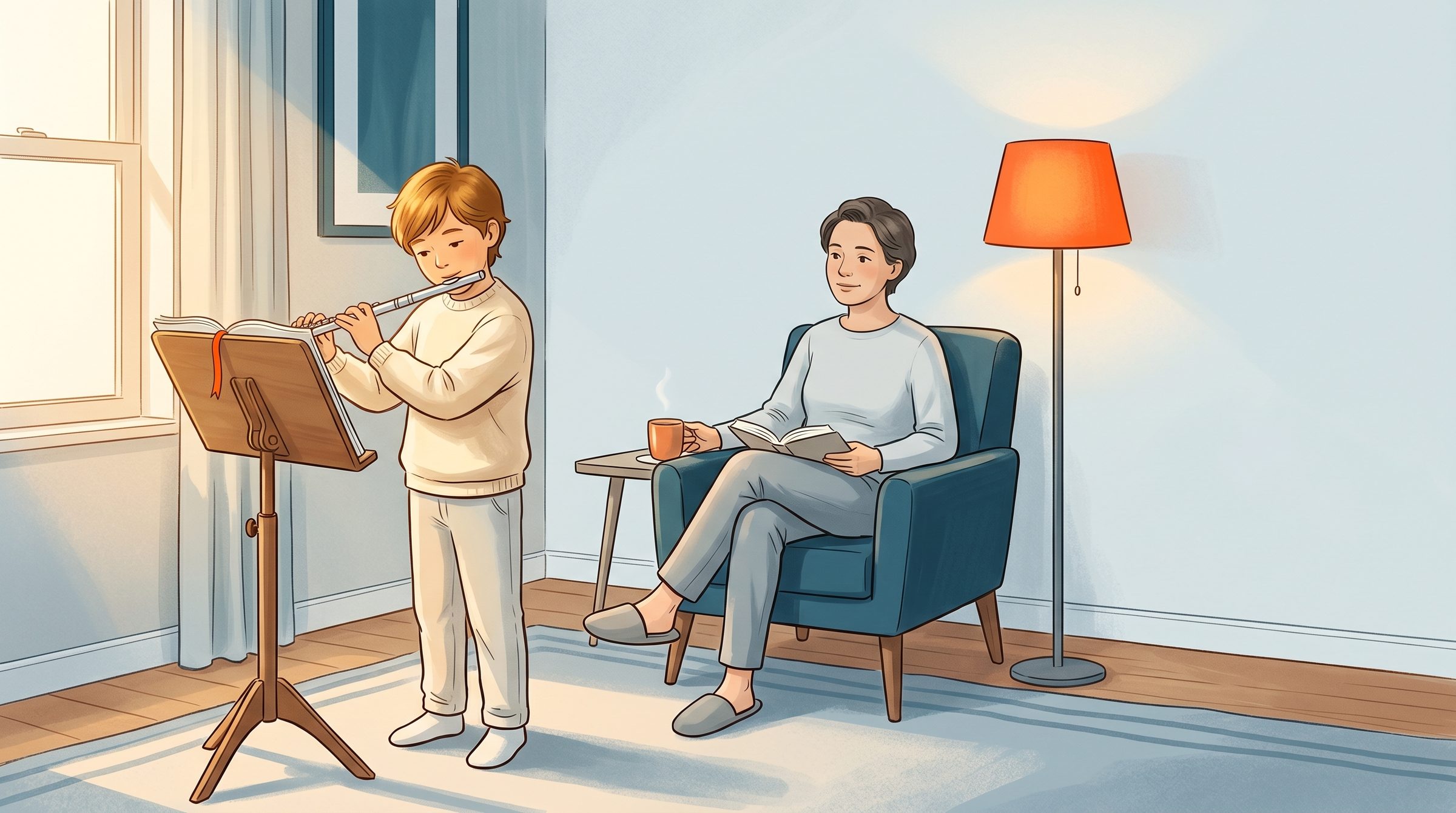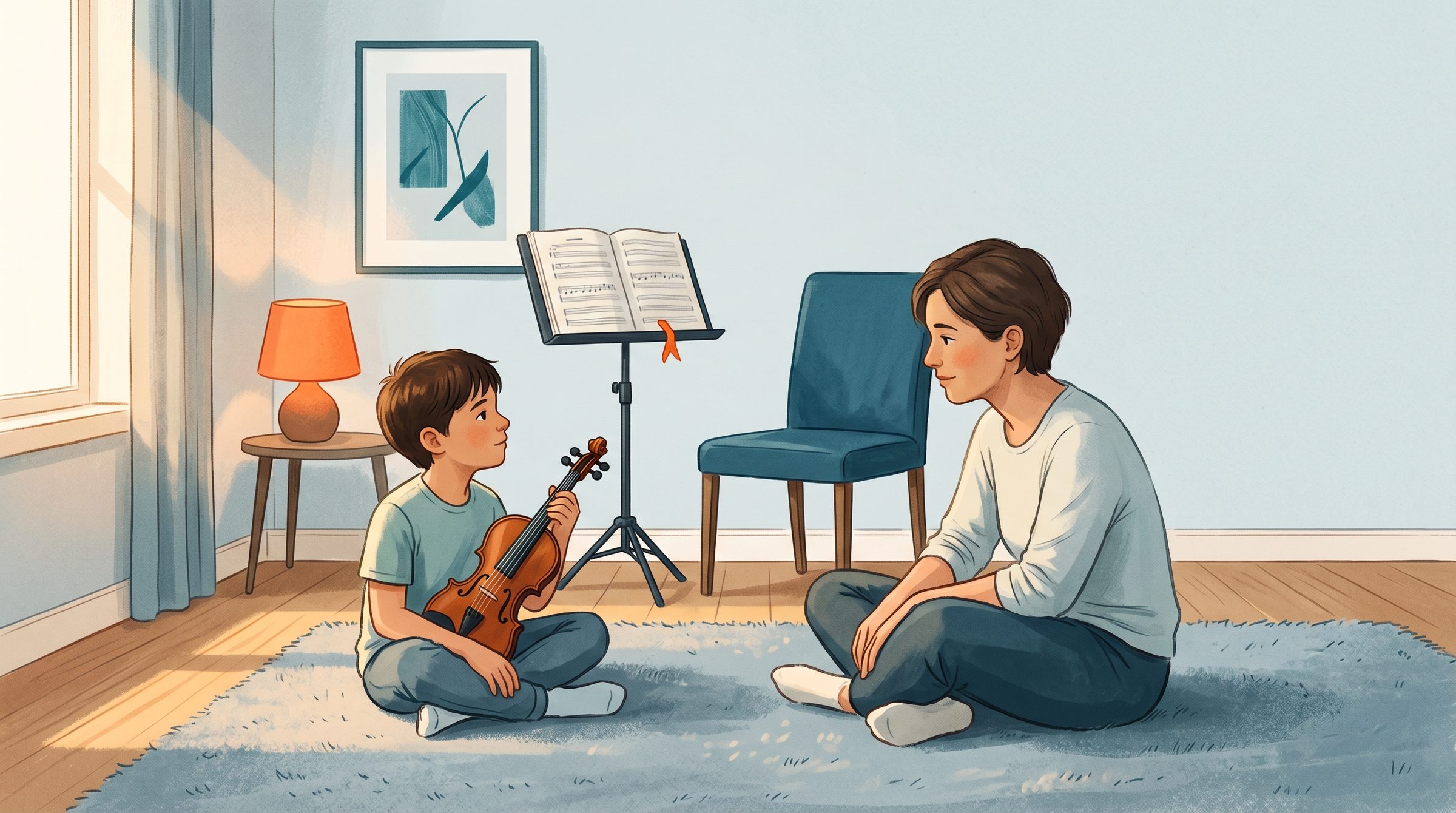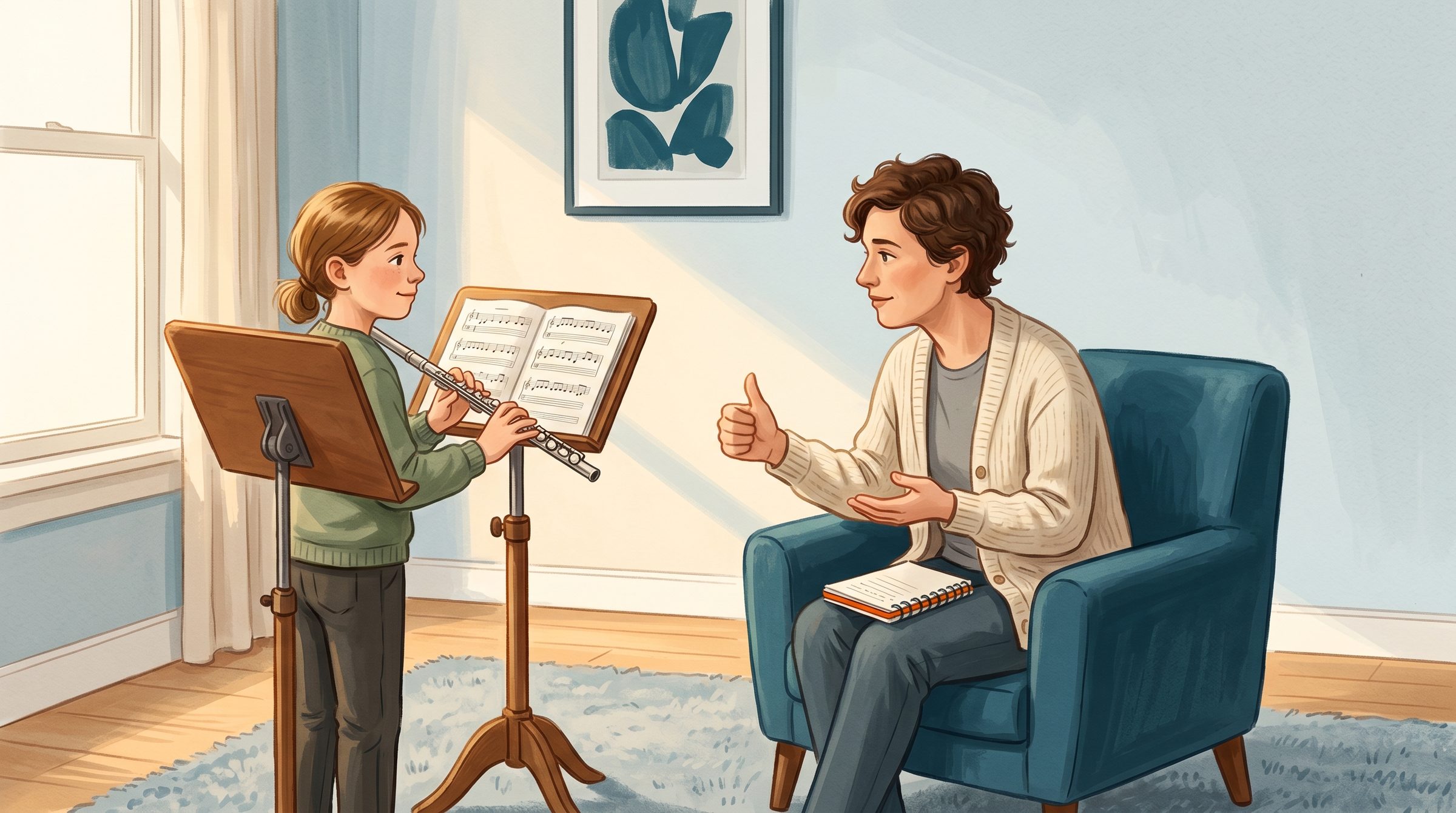
Your child finishes a difficult piece and looks up. You say "that was great!" with a warm smile. They nod, put the instrument down, and the moment passes. What just happened looks like good parenting and probably feels like it. The pedagogical research on motivation suggests it might be doing nothing — and in some cases, it might be making future practice harder. Knowing how to praise your child's music practice the right way is a smaller skill than most parenting advice makes it sound, and it has a lot in common with not praising at all.
Praise Is Not Always Encouragement
Parents praise to encourage. The unstated assumption is that any positive comment is better than none. The motivation research is more nuanced: how you praise matters more than whether you do, and certain kinds of praise consistently undermine the thing they are trying to support.
The core distinction is between outcome-focused praise ("you played that beautifully") and process-focused praise ("you went back and slowed down that hard passage three times — that's exactly how it works"). Outcome praise rewards the result. Process praise rewards the strategy that produced the result. Long term, only one of those is repeatable. [1]
The Musicologie parenting guide and the broader pedagogical consensus point to the same conclusion: the things parents say after a practice session shape what the child believes practice is for. If practice is for producing pretty-sounding outcomes, the child will learn to avoid activities that produce ugly-sounding work-in-progress. If practice is for noticing and fixing problems, the child will learn to seek out the messy middle where actual learning happens. [2]
Why "You're So Talented" Backfires
Of all the things parents commonly say, "you're so talented" is among the most counterproductive. It feels generous. It often lands as a small landmine.
Talent praise frames the child's ability as fixed and innate — something they are, not something they do. Children who internalize a fixed-talent framing tend to avoid challenging material, because difficulty threatens the identity. If the next piece is hard, and they are someone who is "talented," then struggling with it means the talent has limits, which is scarier than just not trying. The result: a child who plays well below their actual capacity because the easy stuff confirms the identity and the hard stuff endangers it.
The same problem shows up with related phrases — "you have such a good ear," "you're a natural," "music just comes easily to you." All of them attach the praise to who the child is rather than what the child did. None of them give the child a strategy to repeat.
The fix is simple in principle and slightly harder in practice: when something good happens, comment on the action that produced it, not the talent that supposedly explains it. "You stopped and figured out the rhythm" beats "you're so talented" every time, even though the second sounds warmer in the moment. [3]
Process Praise: What It Sounds Like and Why It Works
Process praise focuses on what the child did — the strategy, the persistence, the choice to slow down — rather than what came out. It works because it rewards the activity that produces progress, which is the activity you actually want to encourage.
A few examples that hold up across instruments and ages:
- "You went back and fixed that rhythm three times. That's how the hard passages get easier."
- "I noticed you slowed down before the tricky bar instead of rushing into it."
- "You spent twenty minutes on the same four measures. That's real practice."
- "You ended on something you can play well. The teacher said that was the goal."
- "You didn't play that piece perfectly today. You played it better than yesterday."
The Krupa parent guide and the Suzuki materials frame this in terms of "easy steps" — celebrating each small structural improvement so the child experiences progress as something they cause rather than something that happens to them. [1]
What makes process praise feel different from outcome praise is that it gives the child a replicable strategy. "That was beautiful" tells them today went well. "You slowed down before the tricky bar" tells them what to do tomorrow.
The Specificity Trap: Vague Praise Produces Vague Effort
A common mistake is process-shaped praise that is still too vague to be useful. "Good practice today!" is technically about the activity, but it does not tell the child what specifically was good. They cannot repeat anything because they do not know what they did.
Specific process praise is harder for non-musician parents because it requires noticing what actually happened during the session — the stopping, the slowing down, the going back, the breathing before a hard run. None of those require musical knowledge. They require attention to behavior, not to musical quality.
A useful exercise: at the end of a session, name one specific thing the child did. Not "you sounded great." Not "good practice." Something like "I noticed you stopped after that bar and went back to fix it" or "you stayed with the metronome longer than yesterday." If you cannot name something specific, the praise probably should not happen — silence is better than vague approval, which children quickly learn to discount.
How to Praise When You Cannot Hear Whether It Was Good
Most non-musician parents face the same problem: you cannot reliably tell whether the playing was actually good. The practical answer is to stop trying to evaluate musical quality and start observing behaviors you can see.
Things you can absolutely judge without musical training:
- Whether the child stopped and went back to fix something
- Whether they slowed down a passage that was giving them trouble
- Whether they used the metronome
- Whether they ended on a piece they enjoy
- Whether they showed persistence when something didn't work the first time
- Whether they kept going through frustration without quitting
All of these are behavioral. None of them require knowing whether the F-sharp was in tune. And all of them are precisely the things deliberate practice is built on — which means praising them is praising the activity that produces real progress.
Laurie Niles' practice tips for parents at Violinist.com makes the same point: parents do not need to evaluate the musical output to give meaningful encouragement. They need to notice the work that produced it. [4]
If you cannot tell whether something sounded good and you want to say something genuine, the safest move is to ask — "what was the hardest part today?" — and then respond to whatever the child says. They will tell you what was difficult, and you can praise the choice to work on it. That is honest, specific, and never wrong.
Building a Practice Culture Where Effort Is Visible
Praise is not the only signal you send. Across weeks and months, the entire dynamic around practice tells the child what is being valued. A few patterns that compound:
- Asking "what did you work on today?" instead of "did you practice?" — the first invites a description of effort, the second invites a yes/no
- Showing genuine interest in the hard parts, not just the polished pieces
- Talking about pieces in progress as if they are interesting on their own, not just as steps toward an eventual performance
- Letting the child hear about the work the teacher does — preparation, technique, listening — so practice feels like apprenticing into something real
- Being unimpressed by "perfect" run-throughs that have not actually progressed since last week, and being impressed by the messy version that worked through a problem
The NPR reporting on Suzuki teachers makes the underlying point: protecting motivation in young musicians is less about what you say in any one moment and more about what you consistently treat as worth your attention. If parents only show up for the polished moments, children learn to perform. If parents show up for the messy middle, children learn to practice. [5]
For the broader picture of what supportive parenting looks like during practice, see how to help your child practice music. If your home situation has tilted in the other direction and praise has stopped working, why your child hates practicing music covers the diagnostic side.
The simplest version of the rule fits in one line: when in doubt, praise the doing, not the being, and never both at once.
One last practical note for non-musician parents: tools like AIMU can help with the "what specifically did the child do today" problem by giving you a visual report of which passages were worked on and how they progressed across the session. That gives you an honest, specific thing to acknowledge — even when you cannot tell whether the playing itself was good. Process praise is easier when the process is visible.
Further reading
- 5 Easy Steps to Help Your Child Practice at Home (Kinga Krupa)
- How to Practice: A Guide for Parents and Caregivers (Musicologie)
- Eight Helpful Tips to Help Your Child Practice at Home (Suzuki Music Institute)
- Practice Tips for Parents (Laurie Niles, Violinist.com)
- Getting Kids to Practice Music Without Tears or Tantrums (NPR / Deceptive Cadence)