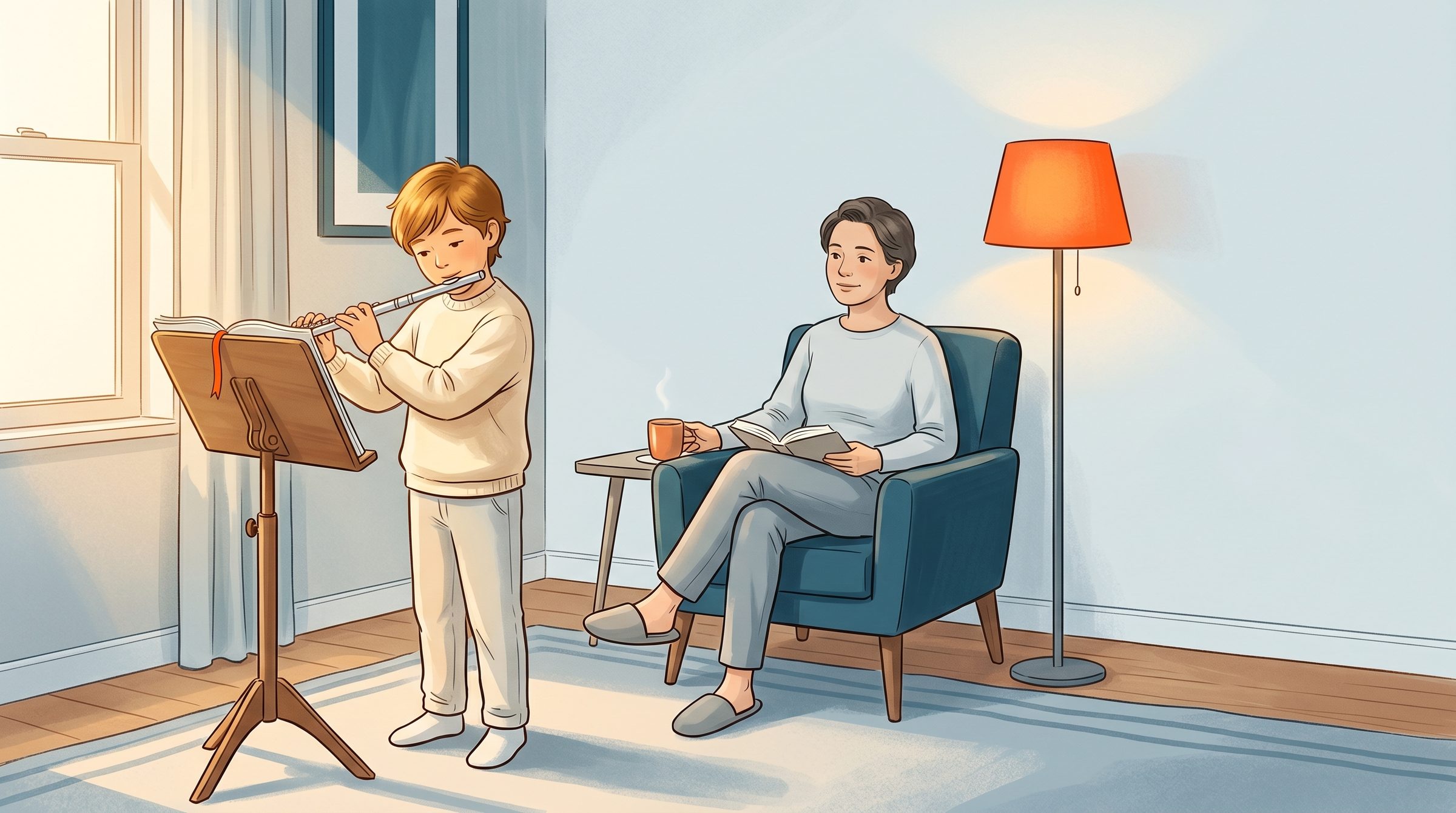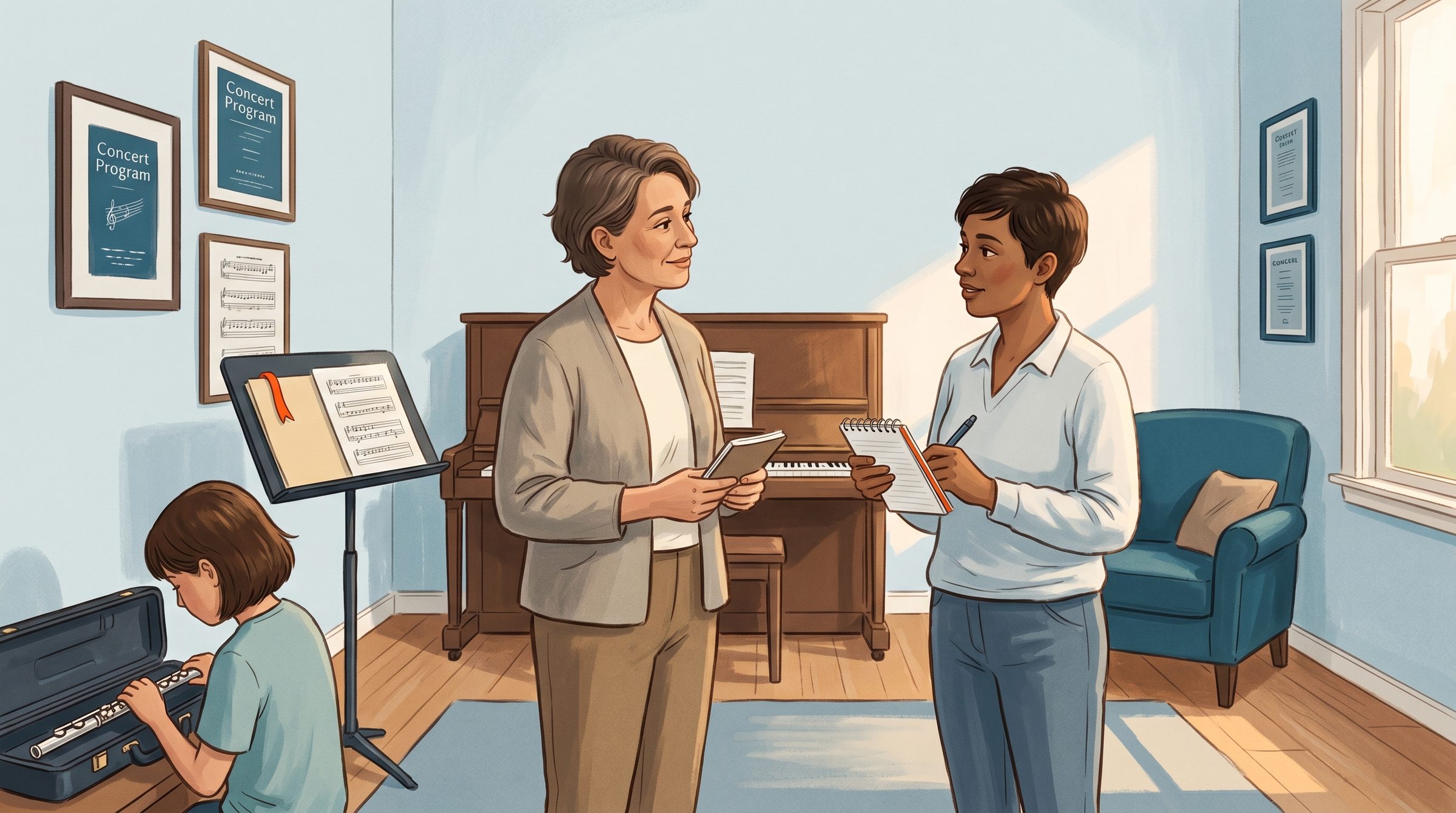
Your daughter has been taking flute lessons for six months, and you have spoken to her teacher exactly twice — both times for thirty seconds at the end of a lesson. You don't read music. You aren't sure what to ask, or whether your questions sound naive. That hesitation is the single most common reason parents miss out on the most useful adult in their child's musical life. Knowing how to talk to your child's music teacher is a skill, not a personality trait — and it has very little to do with whether you can read a treble clef.
Why Parent-Teacher Communication Matters More Than You Think
The Suzuki method has organized music education around a single idea for decades: the parent, the teacher, and the child form a triangle, and the strength of any one side affects the other two. Most non-Suzuki families never get told this explicitly. Most non-musician parents drift into the role of "the person who pays the bills and drives to lessons." [1]
That role works, but it leaves the most valuable part of the partnership on the table. A teacher who never hears from a parent operates on incomplete information. They see thirty minutes a week of polished lesson behavior. They cannot see the home struggle, the boredom, or the breakthrough nobody mentioned. The Musicologie guide for parents puts it plainly: the parent's job is to help the child understand how to practice — and that requires real communication with the teacher about how. [2]
This does not mean becoming a co-teacher. It means closing the information gap so the teacher can teach better and the child can practice with less guesswork at home.
What to Ask the Teacher (and What Not To)
The single most useful question a non-musician parent can ask after a lesson is: "What is the one thing we should focus on this week at home?"
It seems simple. It is not. Most parents default to "How is she doing?" — which puts the teacher on the spot to summarize a complex student in one sentence. The answer is almost always something kind and useless: "she's doing great." That tells you nothing you can act on for the next seven days.
Specific questions produce specific answers. A few that work in real lessons:
- "What is the one thing we should focus on this week?"
- "If she only practices twenty minutes a day, what should those twenty minutes be?"
- "What is the difference between a productive practice session and an unproductive one for her right now?"
- "Is there a passage you would like her to slow down on this week?"
- "Is there anything that would help if I noticed it at home?"
Avoid pre-loaded judgments ("She's not practicing enough, right?"), comparisons to other students, and any version of "Why isn't she better at this yet?" These questions ask the teacher to confirm an anxiety, not to teach. [2]
How to Take Useful Lesson Notes Without Knowing Music
Note-taking is the single most useful thing a non-musician parent can do at lessons. The Suzuki framework requires it for young students, and even one or two lines after each lesson transforms the week. [1]
You do not need musical vocabulary. Write down what the teacher said in plain English:
- "Slow down the second line — the rhythm gets fast."
- "Practice bars 9 to 12 separately before playing the whole piece."
- "Long tones at the start of every session."
- "End every session by playing through one piece she likes."
If you do not understand a term, ask. "What does articulation mean here?" is not a stupid question. It is the question that turns a confused homework list into something your child can actually practice.
How to Share Practice Concerns Without Sounding Critical
If something is going wrong at home — daily fights, the same passage causing tears, a piece that has been "almost done" for three weeks — the teacher needs to know. The trick is sharing the information without sounding like you are blaming the teacher or the child.
Use observations, not conclusions. "Bar 12 has been a battle every day this week" is a useful sentence. "She is frustrated and I think the piece is too hard" is a conclusion that pre-empts the teacher's judgment. The first lets the teacher decide what to change; the second invites a defensive response. [4]
Frustration at home is teaching information. Elizabeth Leehey, writing about the home practice environment, makes the point that what happens during the week tells the teacher more than what happens during the lesson — but only if the parent reports it without judgment. [5]
The other rule: do not surprise the teacher. If you have a serious concern, raise it before you start considering changing teachers, dropping the instrument, or escalating. A short message before the next lesson — "Bar 12 is becoming a battle, can you take a look?" — usually changes the lesson plan and resets the home dynamic.
When to Get the Teacher Involved in Practice Problems
Some practice problems are normal. Some need the teacher's attention. The line is roughly this:
Normal — handle at home:
- Occasional resistance to starting a session
- Frustration with a difficult passage that resolves within a few sessions
- Boredom with a single piece
- A bad day after a long week at school
Get the teacher involved:
- The same passage is a meltdown trigger every day for more than a week
- Your child is asking to quit, repeatedly
- A piece has been "almost done" for more than a month with no visible progress
- The child is developing pain or strain you suspect is technique-related
- The home practice atmosphere has become consistently negative
The earlier you flag something, the easier it is to fix. Teachers can adjust lesson plans, swap repertoire, or change pace — but only if they know there is something to adjust. Many parents wait too long because they do not want to seem demanding, and the result is usually that a small fixable issue becomes a big quitting decision.
How to Build a Long-Term Partnership With Your Child's Teacher
The best parent-teacher relationships look more like a quiet professional partnership than a client-vendor transaction. They share information regularly, they never go around each other, and they treat the child's progress as a joint project. A few things that make this work over years:
- Show up to student concerts and recitals even when your child isn't playing — it tells the teacher you take their work seriously, and your child notices too
- Pay on time and don't haggle — teachers are usually underpaid, and reliability is the easiest way to be the parent every teacher remembers fondly
- Ask the teacher how they prefer to communicate (text, email, end-of-lesson chat, brief parent meetings) and use that channel
- Tell them when something goes well — a concert that landed, a piece that finally clicked, a moment of pride at home. Teachers rarely hear it
If you do these five things — ask specific questions, take real notes, share concerns as observations, escalate small issues early, and respect the teacher as a professional — you will be in the top five percent of parents your child's teacher has ever worked with. None of it requires knowing how to read music. It requires treating the teacher as a partner instead of a vendor, and showing up consistently for years.
For the broader picture of what supportive non-musician parenting looks like during practice, how to help your child practice music covers the routine and mindset side. If you want to share something with an older child to help them structure their own session, how to practice music at home is written for the student themselves.
A practical companion to all of this is having visibility into what is actually happening between lessons. Tools like AIMU listen to home practice and produce visual progress reports a non-musician parent can read — and a teacher can review at the next lesson. It does not replace the conversation with the teacher. It gives both of you something concrete to talk about.
Further reading
- Eight Helpful Tips to Help Your Child Practice at Home (Suzuki Music Institute)
- How to Practice: A Guide for Parents and Caregivers (Musicologie)
- 5 Easy Steps to Help Your Child Practice at Home (Kinga Krupa)
- Getting Kids to Practice Music Without Tears or Tantrums (NPR / Deceptive Cadence)
- Creating an Optimal Music Practice Environment for Your Child (Elizabeth Leehey)