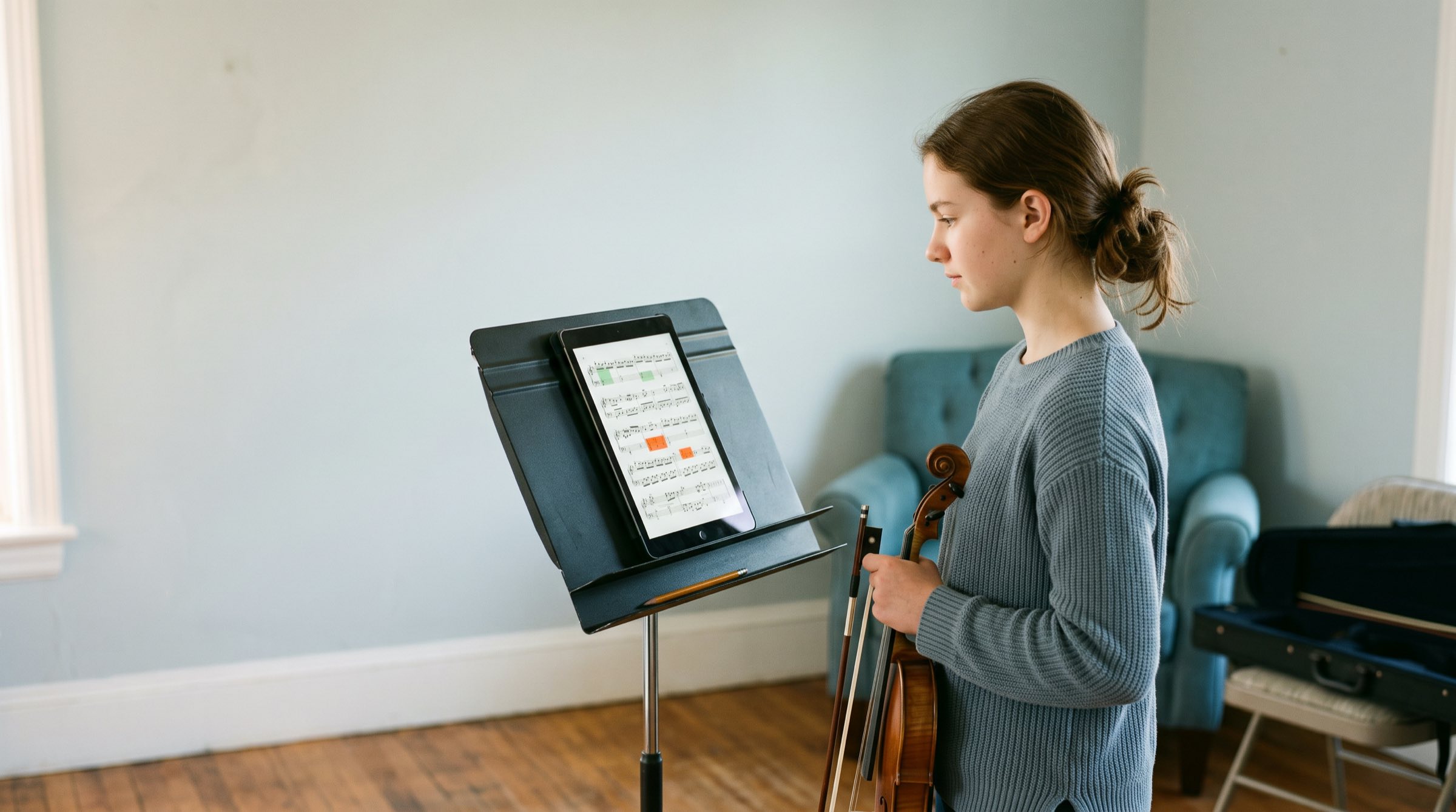
Most students meet the piano part a week before the recital. Until then they practice their line alone, and the first rehearsal feels like a different piece. Practicing with piano accompaniment from the early weeks fixes that: you learn the harmony, the entries and the tempo together, the way you will perform them.
What changes when you hear the piano part
Alone, you hear one line. With the piano, you hear where each of your notes sits in the chord, so a sharp F or a flat C stands out against the harmony instead of passing unnoticed.
The rests change too. Four bars of rest in your part are four bars of music in the piano part, and you have to count through them to come in on time. Students who only practice alone often rush these bars, because silence feels longer than it is.
When the accompaniment matters: lessons, exams, recitals
Graded exams expect it. In ABRSM's Performance Grades for bowed strings, "a piano or string accompaniment is required for all pieces", except studies and pieces marked SOLO. [1]
The same syllabus allows the accompaniment to be live or recorded, and says recorded accompaniments "may be commercially-available tracks or recordings made specifically for the candidate's exam." If you play an exam piece, practicing with the piano part is preparation for the exam itself, not an extra.
Four ways to practice with accompaniment
- A live pianist. The best rehearsal partner, because a pianist follows your rubato and breathes with you. The limit is time: most students get one or two rehearsals before a concert.
- Recorded tracks. MP3s and YouTube play-alongs are easy to find for standard repertoire. They run at one fixed tempo, and you can't isolate the bars you need.
- Notation playback. Free notation software such as MuseScore plays the piano part of a score you enter or import. [2] It works, but the sound is basic and setting up each piece takes time.
- Practice apps. Appcompanist offers piano accompaniments for singers, with control over key and tempo. [3] For string and wind players, AIMU plays the parts of your own score (details below). The comparison of music practice apps covers the other options.
A five-step routine with the piano part
- Learn your notes alone first. Get the fingerings and bowings secure at a slow tempo. The piano adds information; add it once your own part stops surprising you.
- Play with the piano at a slow tempo. Slow the accompaniment down to a speed where you can listen to the harmony while you play. The guide to practicing slowly explains why speed comes later.
- Loop the entries. Isolate every place where you come in after a rest or after the introduction. Play the two bars before and the two bars after, until the entry is automatic.
- Bring it up to tempo in steps. Raise the tempo a few beats per minute at a time. If the ensemble falls apart, go back one step.
- Record a full run-through and listen. Listen for the places where you and the piano drift apart. Those bars go on tomorrow's list.
Four problems the piano part reveals
- Rushing through rests. Count the rest bars out loud once with the piano. Then count them in your head.
- Late entries after the introduction. Learn the last bar of the piano introduction as well as you know your first note. It is your cue.
- Drifting tempo. When the piano stays steady and you don't, the recording shows it at once. Mark the bars where you speed up and loop them.
- A track that can't follow you. Recordings don't wait for your rubato. Use them to learn the piece, and plan at least one rehearsal with a live pianist before you perform.
How AIMU plays the piano part with you
AIMU plays every part of a score, together or on its own. With a solo and piano piece, you can hear both parts together, the piano alone, or your part alone. The same works for larger scores: the four voices of a choir, or the parts of an orchestra or band.
You can slow the playback down, loop the bars you are working on, and upload your own PDF sheet music, including pieces with a piano part. When you are ready, record yourself and AIMU marks each note on the score, so you see which bars need work before your next lesson or rehearsal.
Start with the free plan and try it on the piece you are preparing now.