The teacher said your seven-year-old needs help structuring practice at home. The teacher's brother-in-law, also a violinist, says you should leave the kid alone and let her figure it out. Both are sometimes right. The honest answer to "should I sit with my child during music practice" depends on the child's age, what you mean by sitting with them, and whether your presence is supportive or supervisory — three things the pedagogical literature actually has clear positions on, even when individual teachers disagree.
The Short Answer Depends on What "Sitting With Them" Means
There is a meaningful difference between three kinds of parental presence during practice, and they produce very different outcomes:
- Coaching presence: the parent corrects technique, comments on mistakes, manages the session minute-by-minute. This is appropriate only in the very specific Suzuki context with a trained Suzuki parent — and even there, it tapers off.
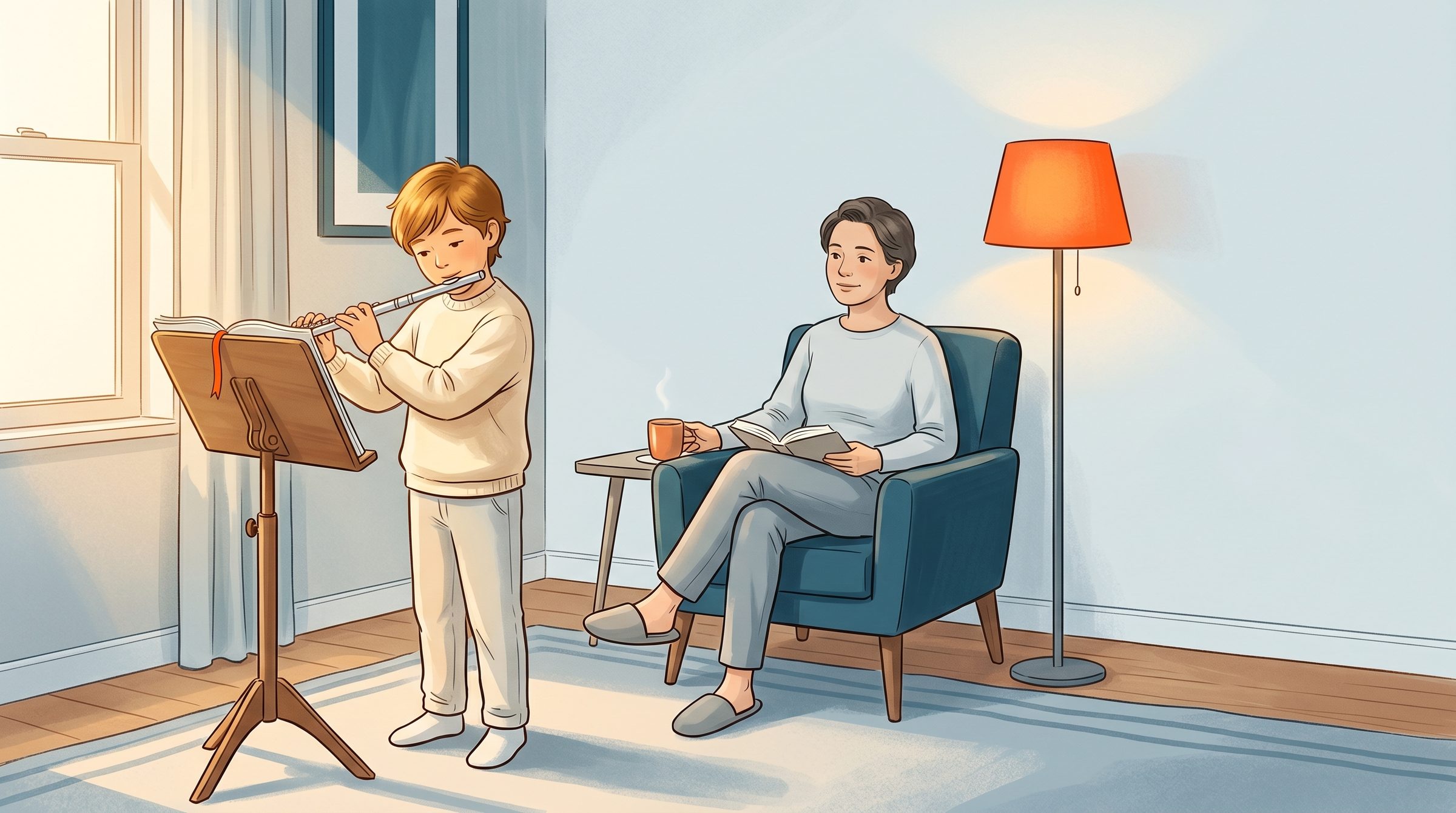
- Supportive presence: the parent is in the room or within earshot, taking notes, offering encouragement at natural moments, and stepping in only when asked. This works at almost every age.
- Surveillance presence: the parent is watching, checking the time, occasionally sighing, and the child is aware they are being judged. This works at no age.
Most parents who ask whether they should sit with their child are quietly worrying about the third — is my watching making this worse? The answer is yes if surveillance is what is actually happening. The fix is not to leave the room. The fix is to change what the presence is for.
What the Suzuki Method Says About Parental Presence
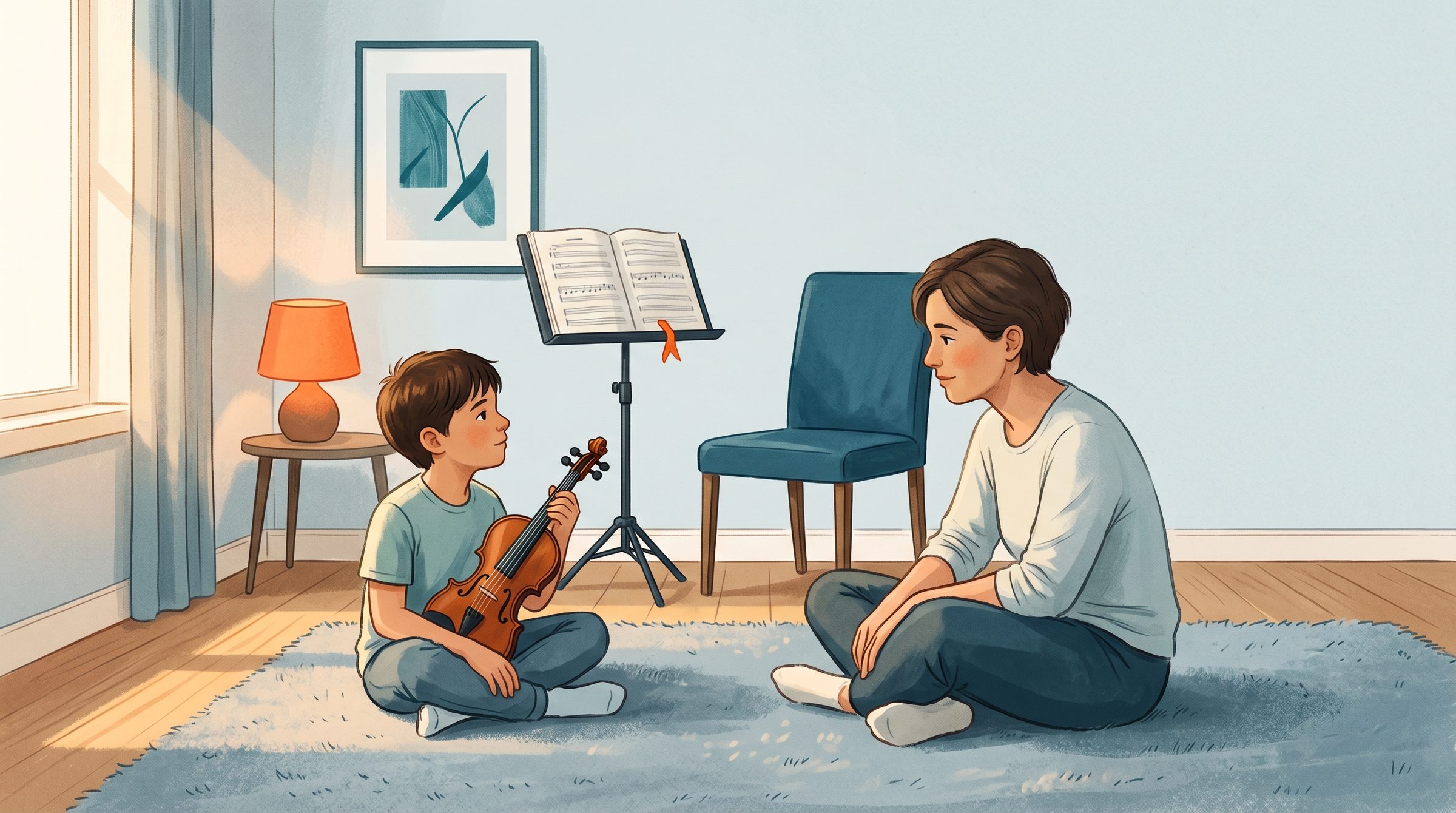
The Suzuki framework is the most explicit on this question. For young children — typically ages four to seven — the parent's physical presence at home practice is treated as a foundational requirement, not a nice-to-have. The parent attends every lesson, takes detailed notes, and then sits with the child during practice to make sure the teacher's instructions are followed. This is the "home teacher" role inside the Suzuki Triangle. [1]
Crucially, "sit with" in the Suzuki tradition does not mean correct continuously. It means be present, refer back to the teacher's notes, and keep the child on the structure the teacher set. The parent is acting as a kind of memory and structure assistant — not as a co-teacher delivering technical feedback they are not qualified to give.
For non-Suzuki families, the principle still applies in modified form: when the child is young enough that they cannot remember what the teacher asked for and cannot structure a session on their own, the parent's presence is the bridge. As the child develops self-regulation, that bridge gradually becomes unnecessary.
When Presence Helps (and Why It's Different From Hovering)
Productive parent presence shares a few specific features. The Musicologie parenting guide describes the productive role as a facilitator — someone who manages the environment and refers back to the teacher's instructions, but does not deliver technical critique. [2]
In practice, that looks like:
- Sitting nearby with the lesson notebook, prepared to remind the child of the day's focus
- Being available when the child gets stuck on something the teacher specifically addressed
- Offering process praise at natural moments — "you went back and fixed that rhythm three times, that's the practice working"
- Not commenting on most notes, most mistakes, or most musical choices
Elizabeth Leehey's writing on practice environments adds another layer: the child needs to feel psychologically safe to make mistakes. A parent's presence that conveys "mistakes are part of practice" supports learning. A presence that conveys "I notice every wrong note" undermines it. [4]
The difference between supportive presence and hovering is mostly internal — what the parent is doing with their attention. A parent reading a book on the couch while glancing up at occasional moments is supportive. A parent watching every measure with active attention is hovering, even if no words are spoken.
When Presence Hurts: The Cost to Self-Regulated Practice
Constant supervisory presence has a documented cost: it interferes with the development of self-regulated practice — the ability to plan, monitor, and correct one's own work without external prompting. Self-regulation is what allows a teenager or adult to practice productively without anyone watching. It is built up gradually through experiences of practicing alone and noticing what worked.
If a child is supervised every minute of every session for years, that capacity does not develop on schedule. The NPR reporting on Suzuki teachers is direct about the risk: when parental presence becomes "constant surveillance" rather than supportive partnership, it can prevent the child from developing the inner sense of practice that they will eventually need. [3]
This is not a reason to suddenly disappear from practice. It is a reason to taper. A child who has only practiced under direct supervision and is suddenly told to do it alone usually flounders, because the structure the parent was providing has not yet been internalized. The transition has to be gradual, and it has to give the child increasing ownership of the structure, not just the time.
How Your Role Should Change With Your Child's Age
The pedagogical literature does not pin a specific transition age. It describes a gradient: the younger the child, the more present the parent; the older, the less. Roughly:
Ages 4 to 7: Active, hands-on parent presence is appropriate and often required. The parent is the structure. Sessions are short (often under fifteen minutes), and the parent is referring back to lesson notes throughout.
Ages 8 to 10: Presence shifts toward facilitator. The parent is in the room or nearby, available, but the child is starting to manage the order of warm-up and pieces. This is when "what's the one thing the teacher asked for this week?" becomes a question the child can answer.
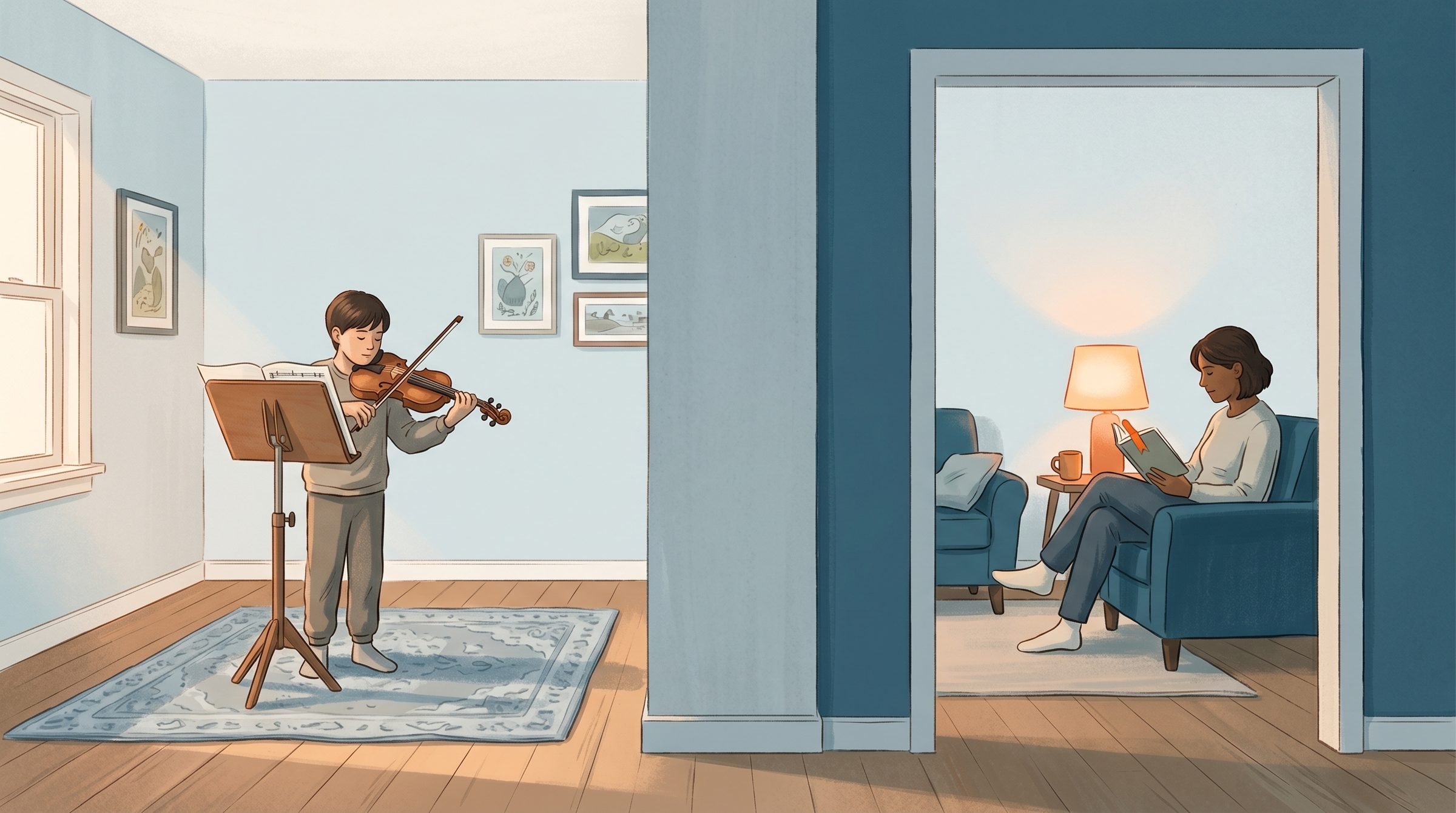
Ages 11 to 13: The child practices alone for most of the session, with the parent within earshot. The parent's role is mostly routine maintenance — same time, same space, occasional encouragement — and intervention only when the child specifically asks or when something is going clearly wrong.
Ages 14 and up: The child practices independently. The parent's role is logistical (lesson scheduling, instrument maintenance, recital attendance) and emotional (encouragement after hard sessions, presence at performances). Sitting in on practice at this age is usually counterproductive unless the teenager has invited it.
The transition age is less about birthdays and more about whether the child can say what they are working on, why they are working on it, and what would make today's session productive. When those three questions get useful answers, the parent's presence in the room is no longer load-bearing.
What to Do (and Not Do) If You Stay in the Room
For the years when presence is still useful, what you do during the session matters more than whether you are physically there. The Suzuki and Krupa parent guides converge on a similar list of useful versus harmful behaviors. [5]
Useful in the room:
- Have the lesson notebook open and visible
- Offer a single sentence of process praise when something specific gets fixed
- Refer to the teacher's notes when the child gets stuck ("the teacher said to slow this part down")
- Be the timekeeper, not the judge
- Stay quiet for most of the session
Harmful in the room:
- Correcting technical details (intonation, fingering, rhythm) without being a trained teacher of that instrument
- Sighing, frowning, or otherwise registering disappointment at mistakes
- Commenting on the duration of practice while it is happening
- Comparing the child's playing to a sibling, classmate, or recording
- Being on a phone or laptop while ostensibly listening — children read the difference between attention and proximity
The single most important rule: do not deliver musical criticism you are not qualified to give. If something sounds wrong to you and the teacher has not flagged it, the right response is to write a note for the next lesson — not to stop the session and correct the child.
For the wider question of what role a non-musician parent can play during practice, how to help your child practice music covers the broader framework. If your home practice has slipped into something more like a daily fight, why your child hates practicing music covers the diagnostic side.
Whether to sit in the room is, in the end, less important than what kind of presence you bring when you do — and whether you are slowly handing the structure of practice over to the child as they grow into being able to hold it.
One thing that helps the transition from supervised to independent practice is having an external way to see what is happening during the session — so the parent does not need to be physically present to know whether the time was productive. Tools like AIMU listen to each session and produce a visual report of which passages got worked on and which improved, which lets the parent step out of the room while still having a quiet way to verify that the structure is holding. The presence becomes ambient, the autonomy becomes real, and the relationship around practice gets a lot less heated.
Further reading
- Eight Helpful Tips to Help Your Child Practice at Home (Suzuki Music Institute)
- How to Practice: A Guide for Parents and Caregivers (Musicologie)
- Getting Kids to Practice Music Without Tears or Tantrums (NPR / Deceptive Cadence)
- Creating an Optimal Music Practice Environment for Your Child (Elizabeth Leehey)
- 5 Easy Steps to Help Your Child Practice at Home (Kinga Krupa)