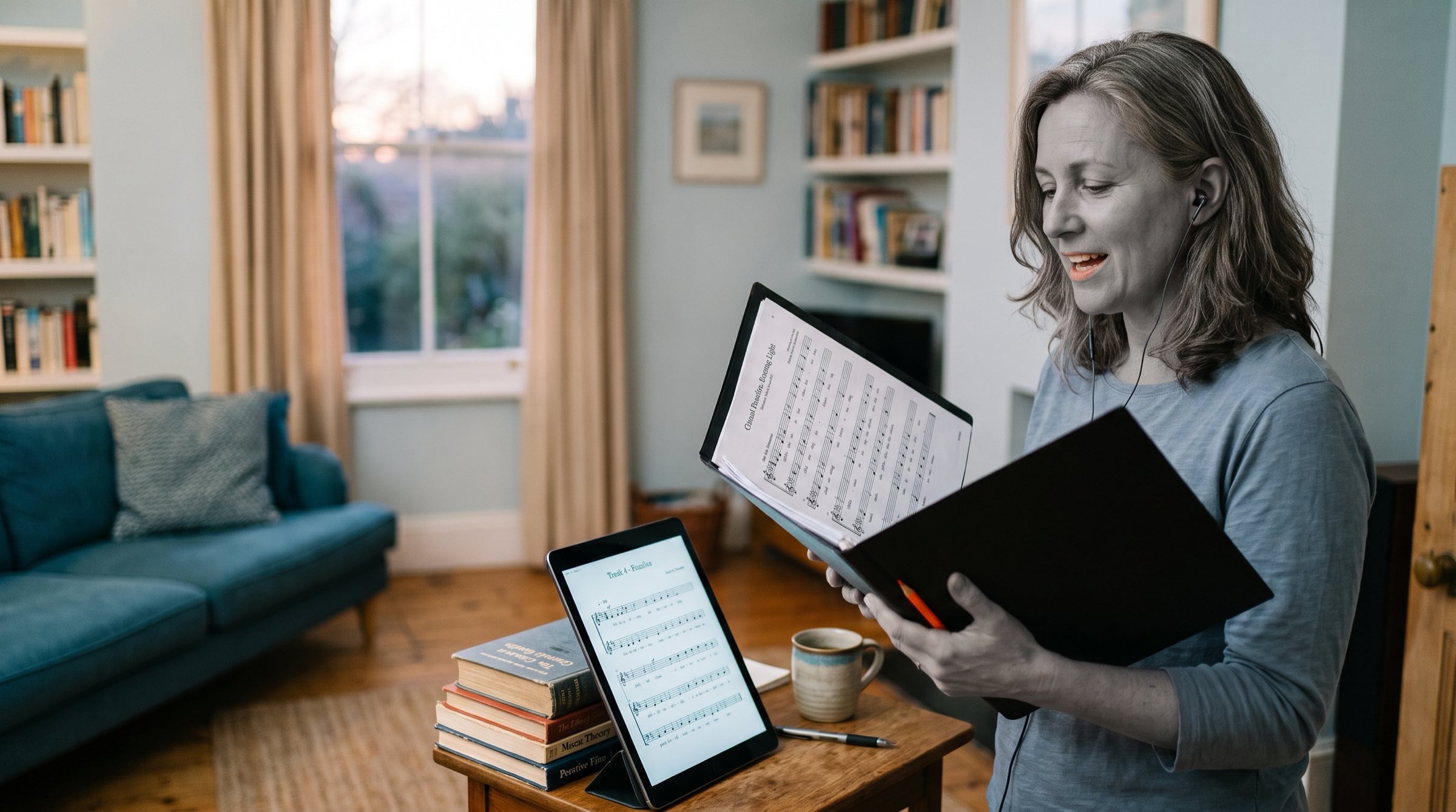
Choir practice tracks let you learn your voice part at home, so you arrive at the next rehearsal with the notes already in your ear. This guide covers what the tracks are, where to get them, and a five-step routine for learning your part.
You are in good company: Chorus America counts more than 54 million Americans singing in choruses [1], and the European Choral Association estimates 37 million choral singers in Europe. [2]
What choir practice tracks are
A practice track, also called a learning track or rehearsal track, is a recording of your piece built for learning one voice part. The Barbershop Harmony Society describes part-predominant tracks this way: they "place a single voice part in one channel, and the other three parts in the opposite channel, so you can quickly hear your part in isolation and as it blends with the other voices." [3]
Choral Tracks, for example, offers three versions of each piece: part-predominant tracks for each voice, balanced tracks with all voices, and accompaniment tracks. [5]
Where singers get practice tracks today
| Source | What you get | Your own sheet music | Price |
|---|---|---|---|
| Choral Tracks | 15,000+ songs as mp3: part-predominant, balanced and accompaniment | No, fixed catalogue | Not stated on the page |
| John Fletcher Music | 13,750+ pieces to stream or download | No, fixed catalogue | Free for out-of-copyright pieces; paid plans |
| Barbershop Harmony Society shop | Learning tracks for barbershop repertoire | No | $36 per song |
| CyberBass | Free MIDI parts, "meant to be used with a musical score in hand" | No | Free |
| Soundslice | Solo or mute parts, slow down without changing pitch, loop, import PDF or MusicXML | Yes | Free tier; paid plans |
| AIMU | Every voice together or isolated, slow down, loop, PDF conversion | Yes | Free plan; from €7.99/mo |
Sources: Choral Tracks, John Fletcher Music, BHS shop, CyberBass, Soundslice, checked 30 September 2026.
Recorded tracks use real singers. Their limit is flexibility: one fixed tempo, and only the pieces in the catalogue. Tools that play from the score, like Soundslice and AIMU, work with the repertoire your director chose, at any tempo.
A home routine for learning your part
- Listen once with the score, without singing. Follow your line on the page while the full choir plays. Mark breaths and entries.
- Sing your part alone, slowly. Use your voice alone at a slow tempo until the pitches and rhythms feel secure. The guide to practicing slowly explains why.
- Add the voice next to yours. Sopranos add the altos, tenors add the basses. Keep your own line while the other part moves.
- Sing against all the other parts. Mute your own part and sing it against the rest. This is the rehearsal situation.
- Work on the entries. Loop the bars before each entry until you find your first note without help.
If your piece has a piano part, the same routine works with the accompaniment: see practicing with piano accompaniment.
Use tracks without losing your reading
Tracks are a support for the score, not a replacement. A 2011 article from the Barbershop Harmony Society put it simply: "let it supplement our music, not drive the car", and warned that the ability to read music could weaken if singers rely on recordings alone. [4]
Keep the score in front of you every time you practice with a track. CyberBass designs its parts the same way, to be used with the score in hand. [8]
How AIMU plays your voice part
AIMU plays every part of a score together or on its own. With an SATB piece you can hear the full choir, your voice alone, or everything except your voice, and switch between them as you work. You can slow the playback down and loop the bars you are learning.
If your director has the score as a PDF, you can convert it and practice the exact edition you sing from. The comparison of music practice apps covers other tools for instrumentalists.
Further reading
- Chorus America, Chorus Impact Study: Singing for a Lifetime (2019)
- European Choral Association, Singing Europe
- Barbershop Harmony Society: part-predominant learning tracks
- Barbershop Harmony Society: Learning tracks, too much of a good thing? (2011)
- Choral Tracks: for individual singers
- John Fletcher Music
- Barbershop Harmony Society shop: learning tracks
- CyberBass FAQ
- Soundslice: practice tools for choir